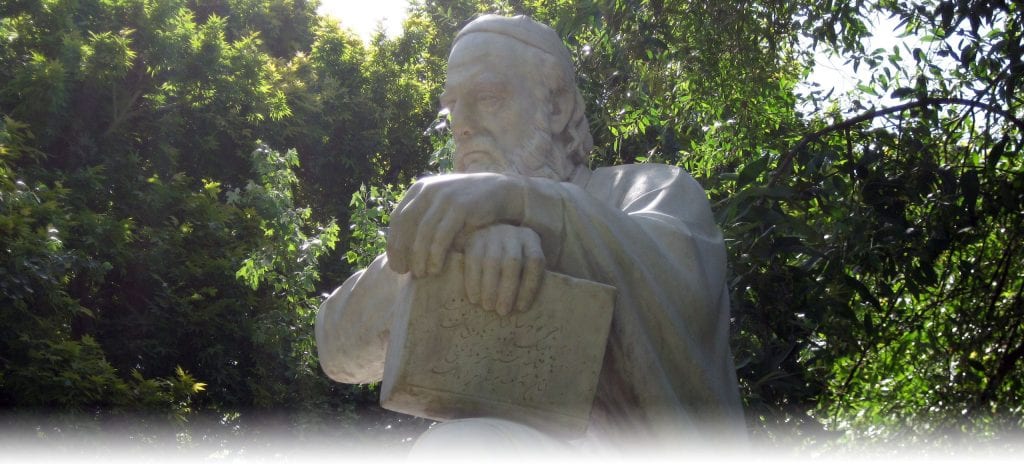

The following essay by Mohammad H. Tamdgidi is the first chapter (pp. 89-138) of the 12th and last book of his series Omar Khayyam’s Secret: Hermeneutics of the Robaiyat in Quantum Sociological Imagination (Okcir Press, 2021-2025). The last book of the series is subtitled, Book 12: Khayyami Legacy: The Collected Works of Omar Khayyam (AD 1021-1123) Culminating in His Secretive 1000 Robaiyat Autobiography. The introduction is subtitled “How Omar Khayyam’s True Dates of Birth and Passing (AD 1021-1123) Were Discovered and Reconfirmed in This Series: Further Explaining and Demonstrating Swami Govinda Tirtha’s Errors in Using Khayyam’s Horoscope for the Purpose.”’
How Omar Khayyam’s True Dates of Birth and Passing (AD 1021-1123) Were Discovered and Reconfirmed in the Omar Khayyam’s Secret Series: Further Explaining and Demonstrating Swami Govinda Tirtha’s Errors in Using Khayyam’s Horoscope for the Purpose
1. Introduction
In this chapter I will provide an overview of the findings originally reported in detail in Books 2 and 3 of this series regarding the discovery and reconfirmation of the true dates of birth and passing of Omar Khayyam (AD 1021-1123).
I will then explain (beyond those already shared) and demonstrate even more of the errors the Indian scholar Swami Govinda Tirtha made in studying Khayyam’s reported horoscope for the purpose—errors that are responsible for the prevalence today of a wrong date of birth (and by implication, of death) for Omar Khayyam.
Although I began my study of Khayyam’s reported birth horoscope in Books 2 of this series with critical notes on the errors made by Tirtha in studying the same as reported in his book in 1941, it is important to note that to discover Khayyam’s true birth date we do not any longer need to rely—beside borrowing from him the idea that Khayyam’s birth date can be learned from his reported birth horoscope—on his study itself or learn about the serious errors he made in the process.
Tirtha had access to limited ephemeris resources in his time, whereas today there are much more detailed and accurate astronomical data (in part also used by astrologists) available to us to fulfill the goal Tirtha set for himself and us to reach.
The horoscope reported by Beyhaqi has not been doubted in all its parts except for the degree of Gemini shared in it, for which various sources have offered different figures over time. Rather than assuming one Gemini degree figure to be the correct one in the exclusion of others, the most accurate astronomical ephemeris information available today can provide us with an opportunity to solve the puzzle by way of a reverse procedure of studying all the yearly data during a reasonable period in which Khayyam’s birth date could have taken place, and determine whether any, one, or more dates provide the data that can fulfill all the other requirements so precisely stated in Khayyam’s reported horoscope.
My reverse method of studying all the yearly data during the AD 1018-1055 period resulted in a definitive finding that there was one and only one date and time, and for only one degree of Gemini (18), in which all the horoscope requirements of Khayyam’s birth chart could be met, solving the puzzle of when Khayyam’s birth took place.
The information then provided the basis for explaining the manuscript copy ambiguities surrounding the Gemini degree. In the next section, I will summarize Books 2 and 3 findings, and in a following section offer further explanations for and demonstrations of Tirtha’s errors in studying Khayyam’s horoscope.
2. Omar Khayyam’s True Dates of Birth and Passing (AD 1021-1123): A Brief Summary of the Findings of Books 2 and 3 of This Series
Book 2 of Omar Khayyam’s Secret series, titled Khayyami Millennium: Reporting the Discovery and the Reconfirmation of the True Dates of Birth and Passing of Omar Khayyam (AD 1021-1123), was devoted to exploring in depth the past findings and controversies surrounding the dates of birth and passing of Khayyam.
In the introduction to the book titled “The Dilemma and Significance of Omar Khayyam’s Dates of Birth and Passing,” I explained how in recent decades, an uneasy consensus has generally emerged in Khayyami studies and public media regarding the dates of birth and passing of Omar Khayyam. Nowadays, one can readily find various online, bibliographic, encyclopedic, academic, or other published sources stating that Khayyam was born on Thursday, May 18, AD 1048, and died on Friday, December 4th, AD 1131. Such dates are then celebrated or commemorated according to the solar Gregorian Christian calendar used today in the West.
The determination of the exact dates for Omar Khayyam’s birth and passing, which would then identify the exact historical period during which he lived (marked by rapidly changing events, rulers, and personalities), is vital for any adequate and realistic research on his life and works amid the broader context of his times.
Studying the interplay between personal troubles and broader public issues affecting Khayyam’s life in a quantum sociological imagination framework—a method of sociological analysis I introduced in detail in Book 1 of this series, for a summary of which see the preface to the present volume—requires a careful determination of the outer boundaries of the chronology of his life and works in relation to those of his contemporaries amid local, regional, and broader world-history contexts.
An accurate determination of the dates of Khayyam’s birth and passing can also provide significant information about more exact intersections of various periods of his biography with those of others amid the tumultuous times during which one or another of his writings, including his poetry, were composed.
The uneasy consensus on Khayyam’s dates of birth and passing as noted above is not a universally settled matter, however, having its origins in a specific piece of biographical information passed on from his time to the present: his birth horoscope, or natal chart. In this regard, the study by the Indian scholar Swāmī Govinda Tirtha has been of singular importance, both in terms of its contributions as well as its errors.
In his book The Nectar of Grace: Omar Khayyām‘s Life and Works (1941), one that included translations of several excerpts of Khayyam’s philosophical (not scientific or literary) writings and his own free translations of quatrains attributed to Khayyam, Tirtha proposed a way of calculating Khayyam’s birth date based on his birth horoscope handed down in a manuscript of biographical entries by the scholar of medieval Islamic period and Khayyam contemporary Zahireddin Abolhasan Beyhaqi, titled Tatemmat Sewan el-Hekmat (Supplement to the Chest of Wisdom).
We owe to Swāmī Govinda Tirtha the wonderful idea of determining the date of birth of Khayyam through a study of his birth horoscope. His efforts at determining Khayyam’s date of passing also offered ideas that shed helpful lights toward solving that question as well.
However, we should keep in mind that the soundness of how he went about determining those dates based on the way he studied the horoscope and other sources using the specific manuscript copies he had at hand is an entirely different matter and in need of critical reevaluation.
In my introduction to Book 2 of this series, I provided some preliminary information about the nature of the Islamic lunar and Iranian Islamic solar calendars as well as Gregorian and Julian Western calendars, while an overview of Khayyam’s tombstones and their inscriptions were also shared.
I then stated my purpose in the book as follows: (1) to carefully and critically revisit Swāmī Govinda Tirtha’s study of Khayyam’s horoscope which lies at the very source of the prevailing uneasy consensus today regarding the dates of birth and death of Omar Khayyam; and, if Tirtha’s findings are verifiably proven to be wrong, (2) to offer an alternative solution to the determination of the true dates of birth (and by implication, passing) of Khayyam by way of careful reexamination of that horoscope.
In the first chapter of Book 2 titled “Contributions, Inconsistencies, and Inaccuracies of Swāmī Govinda Tirtha’s Findings Regarding Omar Khayyam’s Dates of Birth and Passing,” I noted how, in his book (1941), Tirtha tried to resolve long-standing doubts about Khayyam’s dates of birth and passing by way of following up on the clues given in a horoscope for Khayyam’s birth that had been reported in Beyhaqi’s Tatemmat Sewan el-Hekmat (Supplement to the Chest of Wisdom), a passage of which Tirtha said scholars before him had taken notice but had not realized its significance for the purpose at hand (Tirtha, p. XXXII).
Based on Tirtha’s calculations and considerations, Khayyam’s dates of birth and death were then “discovered” by him to be as follows: Birth date: 4:48 a.m., Wednesday, May 18, AD 1048. Date of demise: Thursday, Muharram 12th, 516 LH (falling in the year AD 1122).
In the first section of the chapter, I offered an overview of how Tirtha went about determining Khayyam’s dates of birth and passing. My purpose therein was not yet to critique Tirtha’s efforts. In the second section, however, I explored both the internal consistencies and the factual accuracies of Tirtha’s solutions to the problems of determining Khayyam’s dates of birth and passing. It is one thing to invalidate a claim based on external facts, and another to show that it is internally flawed, that is, it does not even fulfill the conditions it has itself set for its claim.
In offering my critique in that chapter, I first assumed that Tirtha’s reading of Beyhaqi’s reported horoscope is correct. In other words, I took for granted that Tirtha’s reading that at the time of Khayyam’s birth the Sun and Mercury were on the Ascendant “on the third degree” of the Gemini for Neyshabour’s eastern horizon was correct.
I then evaluated whether Tirtha followed his own definitional requirements and procedural guidelines when using Khayyam’s reported horoscope for the purpose of determining Khayyam’s dates of birth and passing, and whether the data he himself provided support his conclusions. I also evaluated Tirtha’s findings in terms of their external accuracy.
By external accuracy I meant to evaluate whether what Tirtha claimed to be the astronomical data or calendrical uses supporting his findings were actually correct. I then showed that his findings have been for the most part both internally inconsistent as well as factually inaccurate.
I demonstrated that there is absolutely no defensible grounds for considering Wednesday, May 18, AD 1048, to be Omar Khayyam’s birth date. For all practical purposes, Iran and the world are celebrating Khayyam’s birth date on the wrong date.
In a following chapter titled “In Search of the Correct Gemini Degree: The Story of How Omar Khayyam’s True Date of Birth Was Discovered Shortly Before Its Imminent Millennium,” I relaxed the assumption of correctness of Tirtha’s reading of the third degree of the Gemini in Khayyam’s reported horoscope, to further evaluate his solutions for Khayyam’s dates of birth and passing.
To answer the question about what had gone wrong in Tirtha’s calculations, I adopted the procedure of step by step peeling away one or another false lead toward a core solution.
The reason for this procedure was to eliminate any other possibilities that may exist and thus cast doubt on the definitive solution we hope to reach for the puzzles at hand. After all, were there more than one solutions that may plausibly compete with, let alone nullify, the solution I offered, we could not claim for sure that a definitive solution had been found.
Finding Khayyam’s birth date considerations on the basis of either “the 3rd” or the 8th degree for the Gemini to be incompatible with the requirements of Khayyam’s horoscope, and encountering a wide range of manuscript source variations as reported in the chapter, I then took the alternative route of directly consulting and reporting the ephemeris data for the entire years during AD 1018-1055.
My procedure for compiling the data was as follows.
I first consulted the Swiss Ephemeris data that is not Neyshabour location specific, and the dates are given for day intervals only and not for the variations during the day. If the data came close to fulfilling the Gemini ascendance and Samimi (Cazimi) requirements, I reported it, cross-checking with the search engine for the more exact Neyshabour location and time variations, to the extent that it was necessary to rule out a date or regarding fulfillment of all the requirements of the horoscope, including the Taslees (Trine) requirement.
In a table serving the purpose I annotated each date sufficiently to explain why that date can be ruled out, or whether it fulfilled a given requirement.
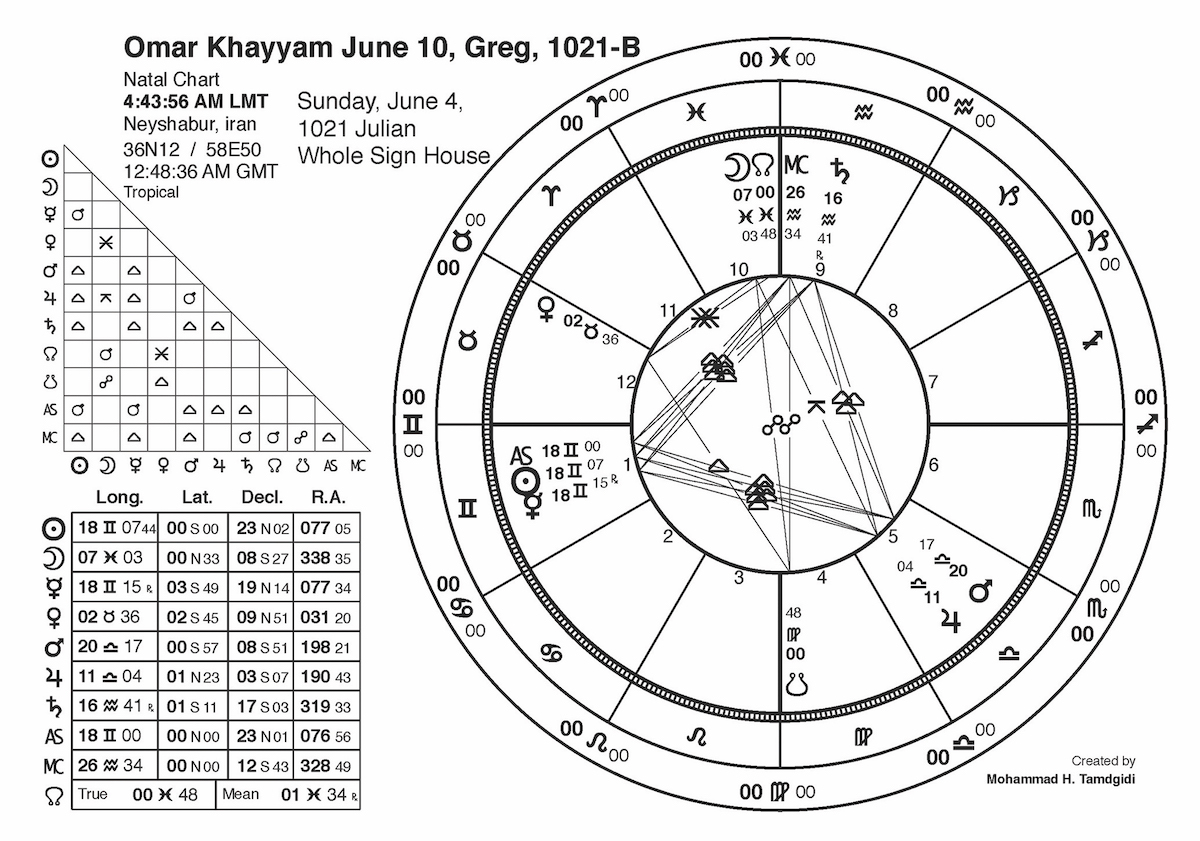
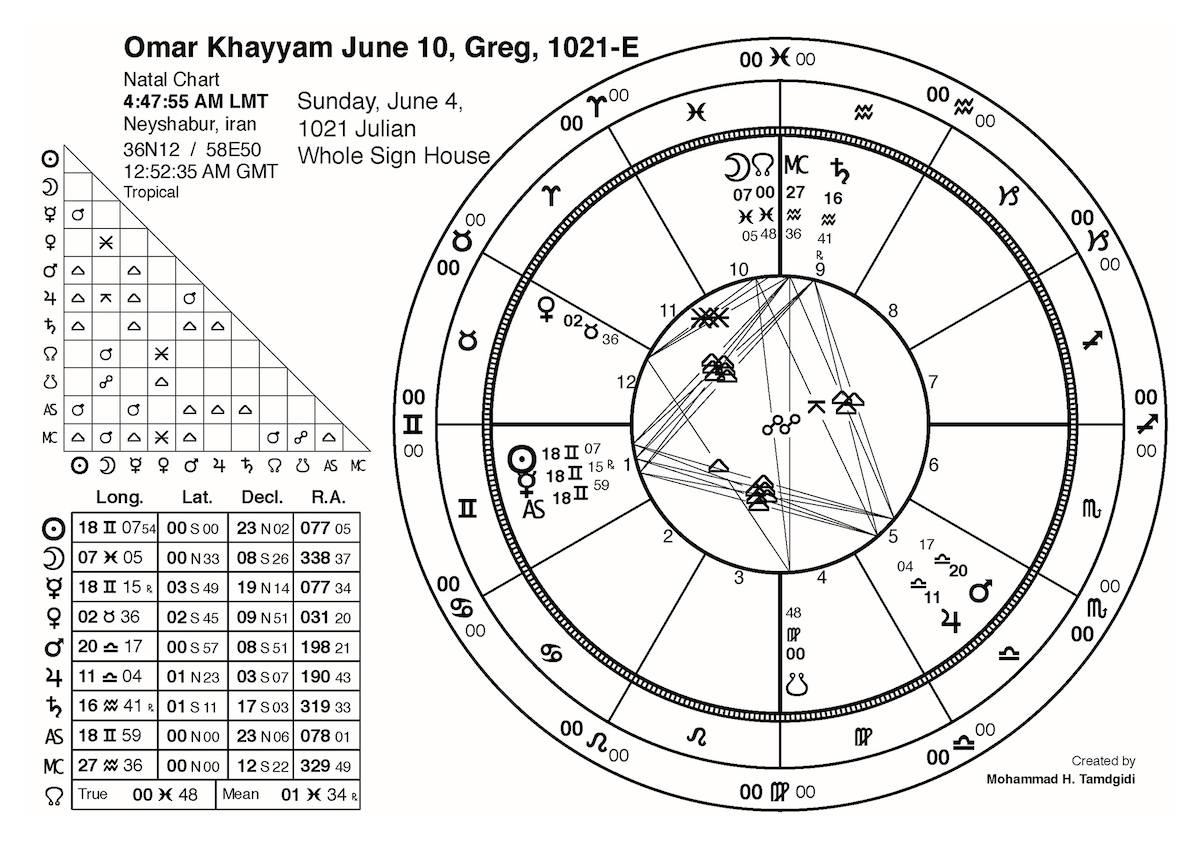
I discovered that there was one, and only one, date between years AD 1018 and 1055 (see Book 2, Table II.3, pp. 30-39, to be reproduced at the end of this chapter as well as Table I.1) that definitively fulfilled all the requirements of Khayyam’s reported horoscope, including the degree of the Ascendant when considering a degree of the Gemini in which the horoscope’s Cazimi/Ascendant conjunction must fall. This date was, in the Gregorian calendar (used today), June 10, AD 1021, at sunrise, Neyshabour’s time.
It was nearly a four minute period from 4:43:56 a.m. to 4:47:55 a.m. exactly at sunrise. During this short interval of time, the Gemini was Ascendant, the Sun and the Mercury were Samimi (Cazimi) on the same degree of the Ascendant 18˚ of Gemini (being in the Samimi distance of 8 minutes from each other), and Jupiter was positioned on the 11th degree of Libra, within a Taslees/Triangulation/Trine-fulfilling distance of about 113 degrees from both the Sun and Mercury.
I then tried further to understand whether the Gemini degree 18 on which the date fell provided any hints about how the ambiguities surrounding the Gemini degree given across the various extant manuscript copies of Khayyam’s reported horoscope could be reconciled with one another.
While explaining the various variations, I discovered that through the process of successive recopying by various scribes, the letter ى became gradually corrupted, the letter being misread as the word فى such that later scribes assumed that the word was not a part of a degree given in abjad for ى but the word فى in the normal part of the sentence.
In fact, I pointed to the existence of a variation, as reported by Rahim Rezazadeh Malek (1998a), in which the Gemini degree had been rendered as يو ح which in abjad numerical values added to the number 18. I also offered explanations for why and how Soviet Russian scholars and astronomers failed in catching Tirtha’s mistakes regarding Khayyam’s date of birth, as well as, in part, his date of passing.
I therefore concluded that, the horoscope of Omar Khayyam as reported by Beyhaqi in his Tatemmat Sewan el-Hekmat (Supplement to the Chest of Wisdom) should be corrected to the following in its Arabic, Persian, and English expressions, further details about the event of his birth I then provided in Book 2 as follows:
«طالعه الجوزا و الشمس و عطارد على درجه الطالع ى ح من الجوزا و عطارد صميمى و المشترى من التثليث ناظر اليهما»
«طالعش جوزا بود و آفتاب و عطارد بر درجۀ طالع ى ح از جوزا و عطارد صميمى و مشترى از تثليث ناظر بر آن دو»
“His ascendant was the Gemini, and the Sun and the Mercury were on the degree of the ascendent 18 of Gemini, and the Mercury was Samimi [Cazimi], and the Jupiter from Taslees [Trine] observing them both.”
Omar Khayyam’s true birth date and stated horoscope features are as follows:
Birth location: Neyshabour, Iran
Neyshabour Coordinates: 36n12, 58e50
Sunday, June 10th (Greg.), AD 1021, or
Yawm al-Ahad (Sunday), Safar 19th, year 412 of Lunar Hejri, or
Yekshanbeh (Sunday), Khordad 20th, year 400 of Solar Hejri, a Leap Year for the Persian calendar (not for the other two calendars)
Omar Khayyams birth took place during a roughly 4-minute period at sunrise when his required horoscope conditions for the beginning and ending of the time period were as follows:
Beginning of the birth time period, Neyshabour, Iran, Time: 4:43:56 a.m.
Starting Universal Time: 12:48:36 GMT
Gemini Ascendant
Ascendant on the degree 18˚ 00´
Sun at 18˚ 7´ 44˝ of Gemini
Mercury at 18˚ 15´ of Gemini (in retrograde motion)
Sun-Mercury Distance was exactly 8 minutes (within 16 minutes range, fulfilling the Samimi or Cazimi requirement of the horoscope)
Sun-Mercury Cazimi is on the degree of the Ascendant 18˚ (at sunrise)
Jupiter at 11˚ 4´ of Libra
Jupiter-Sun/Mercury Distance about 113 degrees and five houses away (within 111-129 range, fulfilling the Taslees/Trine requirement of the horoscope)
Jupiter is not in the visible sky, but behind/below the Earth, “observing” or aspecting along the shorter arc, right-handedly (clockwise), the motions of the Sun-Mercury Cazimi from behind. This also fulfills the Nāzer [observing] requirement of the horoscope.
and
Ending of the birth time period, Neyshabour, Iran, Time: 4:47:55 a.m.
Universal Time: 12:52:35 GMT
Gemini Ascendant
Ascendant on the degree 18˚ 59´
Sun at 18˚ 9´ 54˝ of Gemini
Mercury at 18˚ 15´ of Gemini (in retrograde motion)
Sun-Mercury Distance was exactly 8 minutes (within 16 minutes range, fulfilling the Samimi or Cazimi requirement of the horoscope)
Sun-Mercury Cazimi is on the degree of the Ascendant 18˚ (at sunrise)
Jupiter at 11˚ 4´ of Libra
Jupiter-Sun/Mercury Distance about 113 degrees and five houses away (within 111-129 range, fulfilling the Taslees/Trine requirement of the horoscope)
Jupiter is not in the visible sky, but behind/below the Earth, “observing” or aspecting along the shorter arc, right-handedly (clockwise), the motions of the Sun-Mercury Cazimi from behind. This also fulfills the Nāzer [observing] requirement of the horoscope.
The above are offered below for Persian speaking readers and in Iran’s Persian Islamic Solar calendar:
تاريخ و زمان ولادت حكيم عمر خيام نيشابورى: يكشنبه ١٩ صفر ٤١٢ قمرى، برابر با ٢٠ خرداد سال ٤٠٠ شمسى (سال كبيسه جلالى) و ١٠ ژوئن ١٠٢١ م. (گريگورى)
هنگام طلوع آفتابِ نيشابور
حين چهار دقيقه بين ٤:٤٣:٥٦ و ٤:٤٧:٥٥ صبح، سحرگاهان
طالع: جوزا، درجۀ طالع ١٨ و دقيقه ٠ جوزا
خورشيد: در درجۀ ١٨ و دقيقۀ ٧ جوزا
عطارد: در درجۀ ١٨ و دقيقۀ ١٥ جوزا
خورشيد و عطارد صميمى (فاصله ٨ دقيقه) واقع بر درجه طالع ١٨ هنگام طلوع آفتاب
مشترى در درجۀ ١١ و دقيقۀ ٤ ميزان، با فاصله ١١٣ درجه از عطاردِ صميمى با خورشيد، در تثليث ناظر بر هر دو
I then turned my attention in the same Book 2 to finding the true date of passing of Khayyam. Based on a superposed analysis of Beyhaqi’s Tatemmat Sewan el-Hekmat (Supplement to the Chest of Wisdom), Abdorrahman Khazeni’s Mizan ol-Hekmat (Balance of Wisdom), Nezami Arouzi’s Chahar Maqaleh (Four Discourses), and Yar Ahmad Rashidi Tabrizi’s Tarabkhaneh (House of Joy), and other relevant texts, I reconfirmed in a textually reliable way AD 1123 as the year of passing of Khayyam.
I reminded readers that the currently held date of Khayyam’s passing, that is, Muharram 12th, 526 LH (convertible into the Christian Gregorian calendar date Dec. 11, AD 1131, which is also mistakenly considered as Dec. 4 Gregorian these days) were nonsensical and arbitrarily made.
The choice of “Muharram 12th” simply resulted from a misreading by Tirtha of a birth date given in a source (Tarabkhaneh) for Khayyam as his date of passing.
So, while the years of the date given (555 LH) was misread as such and was obviously wrong to begin with in that source for either Khayyam’s birth or passing, Tirtha (and later others) basically said, “well, why not use the month and day for Khayyam’s passing, anyway.” And they did so, leading to that wrong date for Khayyam’s passing.
We do not have to absurdly borrow a “Muharram 12th” trick from a mistaken date of passing clearly intended as (also a mistaken) date of birth in Rashidi Tabrizi’s Tarabkhaneh to set an exact date of passing for an astronomer and calendar reformer genius that was Omar Khayyam. My findings can provide us with an opportunity for establishing a textually-reliable date of passing falling also on his birth day, one that closes the “circle of coming and going” of his life.
The dates of passing of Omar Khayyam was as follows:
June 10, AD 1123 (Gregorian)
Khordad 20, 502 SH (Persian Islamic Solar Calendar)
Rabi ol-Thani 6, 517 LH (Islamic Lunar Calendar)
At death, Omar Khayyam was a centenarian, aged 102 (in solar years) or 105 (in lunar years). His passing in the lunar month Rabi ol-Thani happened just two months after his birth month Safar, so he had just started his 105th lunar years in age. In other words, we can regard him as having aged 104 lunar years.
تاريخ و زمان وفات حكيم عمر خيام نيشابورى: يكشنبه ٦ ربيع الثانى ٥١٧ قمرى برابر با ٢٠ خرداد ٥٠٢ شمسى و ١٠ ژوئن ١١٢٣ م. (گريگورى)
در سن ١٠٢ سالگى بنا بر تقويم شمسى و ميلادى يا ١٠٥ سالگى بنا بر تقويم قمرى (در واقع فوت وى در ماه دوم ١٠٥ سالگى اش رخ داد)
In Book 3 of this series, I studied in depth Khayyam’s newly discovered true birth date horoscope. Omar Khayyam’s true birth date horoscope is comprised of a dazzling number of Air Triplicities sharing a vertex on a Sun-Mercury Cazimi point on the same Ascendant degree 18 of Gemini. Among other features, his Venus, Sextile with the Moon, also plays a lifelong, secretively creative role to intentionally balance his chart.
These features would not have escaped the attention of Omar Khayyam, a master astronomer and expert in astrological matters, no matter how much he embraced, doubted, or rejected astrological interpretations.
Conducting an in-depth hermeneutic analysis of Khayyam’s horoscope in Book 3 I discovered the origins of Khayyam’s pen name in his horoscope.
My hermeneutic study of Khayyam’s horoscope in intersection with extant Khayyami Robaiyat also led me to discover an entirely neglected signature quatrain that I proved could not be from anyone but Khayyam (because an accurate address is given in the quatrain to the whereabouts of the Gemini degree in Khayyam’s birth chart), one that provides a reliably independent confirmation of his authorship of the Robaiyat.
I also showed how another neglected quatrain reporting its poet as having aged to a hundred is from Khayyam. This meant that all the extant Khayyami quatrains were now in need of hermeneutic reevaluation.
I further studied in Book 3 a sample of fifty Khayyami Robaiyat leading me to conclude that their poet intended the poems to remain in veil, that they were considered to be a collection of interrelated quatrains and not sporadic separate quatrains written marginally in pastime, that they were meant to offer a life’s intellectual journey as in a “book of life,” that the poems’ critically nuanced engagement with astrology was not incidental but essential throughout the collection, and that, judging from the signature quatrain discovered, 1000 quatrains were intended to comprise the collection.
“The Khayyam who stitched his tents of wisdom” was therefore discovered to be a trope that had its inspirational origins in Omar Khayyam’s horoscope heavens.
The series’ Books 2 and 3 should provide interested readers with all that is needed for understanding both the errors made by Swami Govinda Tirtha in calculating the birth date of Omar Khayyam, and how the errors were corrected in the course of my alternative solution to the problem by studying Khayyam’s birth chart.
However, for those needing further explanations regarding Tirtha’s errors, I will devote the rest of this chapter to review his study again, further explaining and demonstrating them.
3. Further Explaining and Demonstrating the Errors Made by Swami Govinda Tirtha in Studying Omar Khayyam’s Reported Birth Horoscope
The following list of errors made by Swami Govinda Tirtha should not be read as a substitute for, but as complementing, the detailed evaluation I already shared in Book 2 of this series, a very brief summary of which I shared above in the previous section of this chapter.
Nevertheless, the list will provide further support for demonstrating the serious errors committed by Tirtha in studying Khayyam’s reported horoscope for the purpose of determining his birth date.
To facilitate the listed elaborations on Tirtha’s errors, I will first share the essentials of the way he framed his study of the horoscope and reported its findings.
1) The Essential Elements of Tirtha’s Approach
Tirtha translated Khayyam’s reported horoscope statement as follows:
His ascendant was the Gemini. The Sun and the Mercury were on the degree of the ascendant in the third degree of the Gemini. The Mercury was “Ṣamīmī,” and the Jupiter was aspecting (Nāẓar) both from triangulation (Tathlīth). (Tirtha, p. XXXII; the transliterations are as found in Tirtha’s book)
He then proceeded, based on the above, to list the following basic horoscope parameters for Khayyam’s birth date, signifying the requirements that needed to be fulfilled for the date he wished to find for Khayyam’s birth date:
(a) He was born at Sunrise.
(b) The Geocentric Longitude of the Sun and Mercury was 63˚ (measured by the Persians from the point of Vernal Equinox 0˚ Aries).
(c) The Geocentric Longitude of Jupiter was 63˚±120˚, i.e., 183˚ or 303˚ within 9 degrees of this position.
(d) Mercury was tending to be Ṣamīm, i.e., approaching towards the Sun so as to come within 16 minutes of an arc. (Tirtha 1941:XXXIII)
Tirtha then made three tries in finding the date he wished to find that would satisfy the above requirements. At this point I will not go into the details of how he arrived at the figures below, since I have already done so in detail in Book 2, and also because I will do so again when elaborating further on his errors later in this chapter.
In his first effort, Tirtha did not offer any specific degree for the Sun other than its being “on the third degree” of Gemini. For Mercury’s position he reported the degree 62.7˚ and for Jupiter’s 306.3˚ (to note, the fractions were stated not in minutes but in decimals, which would translate into 62˚ 42´ and 306˚ 18´ respectively).
In his second effort, Tirtha offered the locations for the Sun, Mercury, and Jupiter to be respectively as follows: 62˚ 23´, 62˚ 46´, and 303˚.
In his third effort, Tirtha reported the following respectively for the locations of the Sun, Mercury, and Jupiter: 62˚ 20´, 66˚ 25´, and 307˚ 1´.
Tirtha considered his first try findings sufficient to announce that Omar Khayyam had been born at sunrise (4 h. 48m. am) on May 18, AD 1048. He claimed that his second and third tries confirmed his first try conclusions.
2) Julian or Gregorian Calendar?
Even assuming that Tirtha’s proposed date May 18, AD 1048, was correct for Khayyam’s birth, following his proposal the world has been celebrating Khayyam’s birth on the wrong date. It would have to be celebrated on May 24, AD 1048.
As I noted in Book 2 (pp. 45-49), there is oddly no indication at all in his study that Tirtha was aware of the distinction between the Julian and Gregorian calendars when he proposed the date May 18, 1048, for Khayyam’s birth date.
The old ephemeris data were compiled in Julian Christian calendar system, whereas today the Gregorian calendar is used in the West. Had Tirtha at least mentioned the distinction and the Julian calendar basis of his proposed date for Khayyam’s birth, his readers and the world today may have been persuaded to make sure it is correctly translated into the Gregorian calendar.
For this reason, the date proposed by Tirtha for Khayyam’s birth date (even assuming for now that it was correct) is being celebrated wrongly on May 18 of each year, when it is more correct to be celebrated on May 24 in the Gregorian calendar used today. May 18, 1048, in the Gregorian calendar translates to May 12, 1048 in Julian calendar, which does not fall on the actual proposed date Tirtha meant to propose for Khayyam’s birth.
While some may consider this shortcoming in Tirtha’s study to be cosmetic and secondary, I think it is important for our consideration for three reasons.
First, it is simply correct scientifically to use the proper calendrical date for a birth date that is supposed to fulfill the requirements of Khayyam’s horoscope. Anyone who searches the astronomical data for May 18, 1048, not knowing that it was based on the Julian calendar, will end up gathering wrong information that would not fulfill Khayyam’s horoscope requirements as Tirtha allegedly outlined in his study.
If Khayyam had meant to convey certain astrological information about his birth chart, researchers would end up studying the wrong data for the purpose.
Second, the person whose birth date is being investigated and celebrated, that is Omar Khayyam, was a renowned astronomer, mathematician, and calendar reformer of his time. So, it seems reasonable and more respectful to expect that the world celebrates his birth date in a way that is calendrically correct (leaving aside for now the question of reliability of May 18, 1048, itself as a correct birth date for him).
Third, a glaring shortcoming such as the above may itself be indicative of other shortcomings in the study undertaken by Tirtha. As I will show further below, there is a pattern in Tirtha’s study of making serious errors that suggest he was not as well versed in the study of Khayyam’s horoscope as he claimed to be, assisted or not by his consulted expert(s).
For this reason, it is important to take note of shortcomings such as the above as expressions of a wider set of problems in Tirtha’s study.
3) How is the Gemini Degree Translated?
The statement of Khayyam’s birth chart as reported by Beyhaqi in his Tatemmat Sewan el-Hekmat (Supplement to the Chest of Wisdom) is generally undisputed except for the degree of Gemini given in the statement. Even assuming that the degree given is 3, about which I will have more to say later, it is important to take note of the way Tirtha translated the statement pertaining to the degree.
The original Arabic text, as Tirtha must have used for his translation of it, is as follows (since the degree number being given in the birth chart in abjad lettering has been subject to variations across manuscripts, let us for now use an X for the number being given, assuming that the word preceding it is فى and not a corruption of another number, as I discovered in my study in Book 2):
«طالعه الجوزا و الشمس و عطارد على درجه الطالع فى X من الجوزا و عطارد صميمى و المشترى من التثليث ناظر اليهما».
This is how Tirtha translated it into English, our focus here being on the expression I have set in bold):
His ascendant was the Gemini. The Sun and the Mercury were on the degree of the ascendant in the third degree of the Gemini. The Mercury was “Ṣamīmī,” and the Jupiter was aspecting (Nāẓar) both from triangulation (Tathlīth). (Tirtha, p. XXXII; the transliterations are as found in Tirtha’s text)
Translating the original Arabic more accurately, we should be expressing the phrase pertaining to the degree as “… were on the degree of the ascendant in X of the Gemini …”. However, we find Tirtha translating it as “… were on the degree of the ascendant in the Xth degree of the Gemini ….” The main difference here is that of referring to the number as X of Gemini or Xth of Gemini.
The difference of referring to the number in terms of X or Xth may seem unimportant, and in a way, should not be important since it is permissible to express the number in both ways, provided that we are aware of the universally used and agreed upon protocols pertaining to reading Zodiac month degrees on astrolabes or birth charts.
However, if we ignore those protocols, using the expression Xth may lead to misunderstandings of how Zodiac month degrees are read in astrology, and consequently of the degree address being given in Khayyam’s birth chart.
I will show later that the way Tirtha translated Khayyam’s horoscope pertaining to its Gemini degree allowed for a misunderstanding on his part (and for those who follow his lead) that is detrimental for a critical evaluation of Tirtha’s study. At this point I only want to draw the reader’s attention to this subtle mistranslation of Khayyam’s horoscope pertaining to the Gemini degree address being given. We should of course also note that Tirtha used the word “degree” twice in his translation, when in the Arabic original, the word “degree” (درجه) is used only once.
4) What Gemini Degree is Translated?
In the original Arabic, as it used to be the case in earlier times, the astronomical numbers for the degrees were given in abjad letters, not in numbers. To abjad letters (which take their name from the first four of the Arabic alphabet, such as A, B, C, D, in the English alphabet), numerical values are assigned.
So, the letter ج being third in the alphabet, is assigned the value of number 3, and the letter ح which is a similar-looking alphabet but lacking the dot, as it can be compared above, is assigned the value of number 8. The letters also appear in small versions ﺟ and ﺣ to which the same numerical values are associated.
As I explained this in more detail in Book 2 (pp. 27-33), since Tirtha does not state anything about the illegibility of the source manuscript for Beyhaqi’s account which he used to translate the horoscope, it appears that he chose to translate what is clearly the abjad letter ﺣ (without a dot, which has a numerical value of 8) as ﺟ (with a dot below it, which has a numerical value of 3).
He does not offer any explanation for his decision, nor does his account show that he had seen variations among his manuscript sources for the abjad letter given in Khayyam’s horoscope. Consequently, Tirtha simply took for granted that the abjad letter/number given in the horoscope is 3, even though in the abjad letter give, it is an 8.
Of course, we cannot fault Tirtha for presumably not having seen other variations for the degree number he read in his source manuscripts, but it is puzzling that in the only manuscript he used for his translation (and an image of which he provided), he opted to translate the abjad letter as 3, and not as it is clearly in the source, 8.
Had he tried exploring the implications of degree 8 and decided the degree does not fulfill Khayyam’s horoscope requirements, opting for number 3 instead? He does not offer any indication that he did so.
From our standpoint more than eighty years later, however, it would be irresponsible to ignore the problem, and unfortunately those not versed in Persian or Arabic may not adequately appreciate the extent of variations found among copies of Beyhaqi’s manuscript.
As I discussed this in detail in Book 2, since Beyhaqi’s book has been widely copied and disseminated over the centuries, a variety of abjad numbers have been cited across the copies by scholars.
As I discussed this matter in detail in Book 2 (pp. 111-127), in his book Daneshnameh-ye Khayyami (Khayyami Encyclopedia), the late Rahim Rezazadeh Malek shared the following report regarding the Gemini degree he had seen across manuscripts to which he had access:
As we have seen in the commentaries about Khayyami, Zahireddin Abolhasan Beyhaqi, in Tatemmat Sewan el-Hekmat, has shared the birth horoscope of Khayyami. This birth horoscope, in the Arabic copies of Tatemmat Sewan el-Hekmat, is as follows:
“His Ascendant was the Gemini and the Sun and Mercury were on the degree of the Ascendant ( – – ) of the Gemini, the Mercury being Samimi, and the Jupiter observing both from Taslees.”1In Rezazadeh’s book, the Arabic texts in the original is as follows: «طالعه الجوزا و الشمس و عطارد على درجه الطالع ( – – ) من الجوزا و عطارد صميمى و المشترى من التثليث ناظر اليهما».
The same piece is rendered as follows in the Persian translation of Tatemmat Sewan el-Hekmat:
“His Ascendant was the Gemini, and the Sun and the Mercury were on the degree of the Ascendant ( – – – ) of the Gemini and [Mercury was Samimi] and the Jupiter observing [both] from Taslees.”2In Rezazadeh’s book, the Persian texts in the original is as follows, the brackets are given in Rezazadeh’s original: «طالعش جوزا بود و آفتاب و عطارد بر درجۀ طالع ( – – – ) الجوزا و [عطارد صميمى] و مشترى از تثليث ناظر [بر آن دو]».
What we enclosed in parentheses with the dash line, in one of the copies of the Arabic manuscript is rendered as (ﺣ) and in other copies as (ح) and (يو)3This corresponds to the letter ى . Basically, it is like saying “Ef” for the letter F, or “Gee” for G. . «آنچه که ميان ابروان جاى آن را خطّ تيره گذاشتيم، در يکى از نُسخ متن عربى (ﺣ) و در نسخه هاى ديگر (ح) و (يو) آمده است. و در ترجمۀ فارسى (ک و ر) است.». And in Persian translation as (ک و ر). (see Rezazadeh Malek 1998: 33-36; my English translation)4«آنچه که ميان ابروان جاى آن را خطّ تيره گذاشتيم، در يکى از نُسخ متن عربى (ﺣ) و در نسخه هاى ديگر (ح) و (يو) آمده است. و در ترجمۀ فارسى (ک و ر) است.»
In other words, Rezazadeh Malek had found variations that included not just 3 or 8, but even 18 (يو ح), and in my study in Book 2, I noted that the variation ك و ر can also be an expression, in an alternative Persian abjad system, of ى ح (having the numerical value of 18) (see Book 2, pp. 111-127 for more details).
In abjad system, for numbers such as 18, having two digits, a combination of abjad letters must be used. I noted in Book 2 that Malek had missed seeing another variation (and image of which I supplied) in which the abjad letter is ﺟ (which has a numerical value of 3).
In Rahim Rezazadeh Malek’s report as summarized above, it is noteworthy that in his reporting of the original Arabic and Persian texts that he had seen (see footnotes below), he included the word فى preceding the abjad letter as part of the abjad number being given for the degree of Gemini ascendant in Khayyam’s horoscope.
In other words, he was convinced that the word فى (meaning “in”) is part of the number of Gemini being given in the birth chart, and in my view he was correct, since the word is redundant (given the word على in the Arabic text and بر in the Persian text express the notion of the degree being in the Gemini already, and there is no need for its repetition by way of using فى as another word). Only those familiar with Arabic language would appreciate this point.
At this point, my purpose is simply to show that while Tirtha may not have had access to a variety of manuscripts to note the disputability of the Gemini degree given in Khayyam’s birth chart, he failed at least to acknowledge, let alone explain, why he had chosen to read the abjad letter given in his source (one that is clearly a ﺣ) as a ﺟ , resulting in his translation of the abjad letter as having the numerical value 3.
5) Do Tirtha’s Findings Fulfill the Horoscope’s “Third Degree of the Gemini” Requirement?
In Book 2, even taking for granted that in Tirtha’s reading Khayyam’s horoscope offers a “third degree of the Gemini” (in Tirtha’s translation) address, I showed that Tirtha’s findings were not consistent with that reading, since the Gemini degrees he had found for the Sun and Mercury fell in the 62˚ range.
Note that as far as my own study of his efforts were concerned as shared in detail in Book 2, it does not in fact matter if the degree is read as three, nor that Tirtha’s findings is in a 63˚ range, since in either case, I showed (and will show again below) that the finding does not fulfill the requirements posed by Khayyam’s horoscope. However, for the sake of demonstrating the internal inconsistency of Tirtha’s approach, I wanted to show another major error in Tirtha’s study.
The reason Tirtha’s findings are inconsistent with a “third degree” (or degree 3) of Gemini reading of the horoscope has to do with the way Tirtha was counting the degrees in the first place, in a way that is contrary to the universal and established protocols of astrology. Those who follow his lead, therefore, commit the same error.
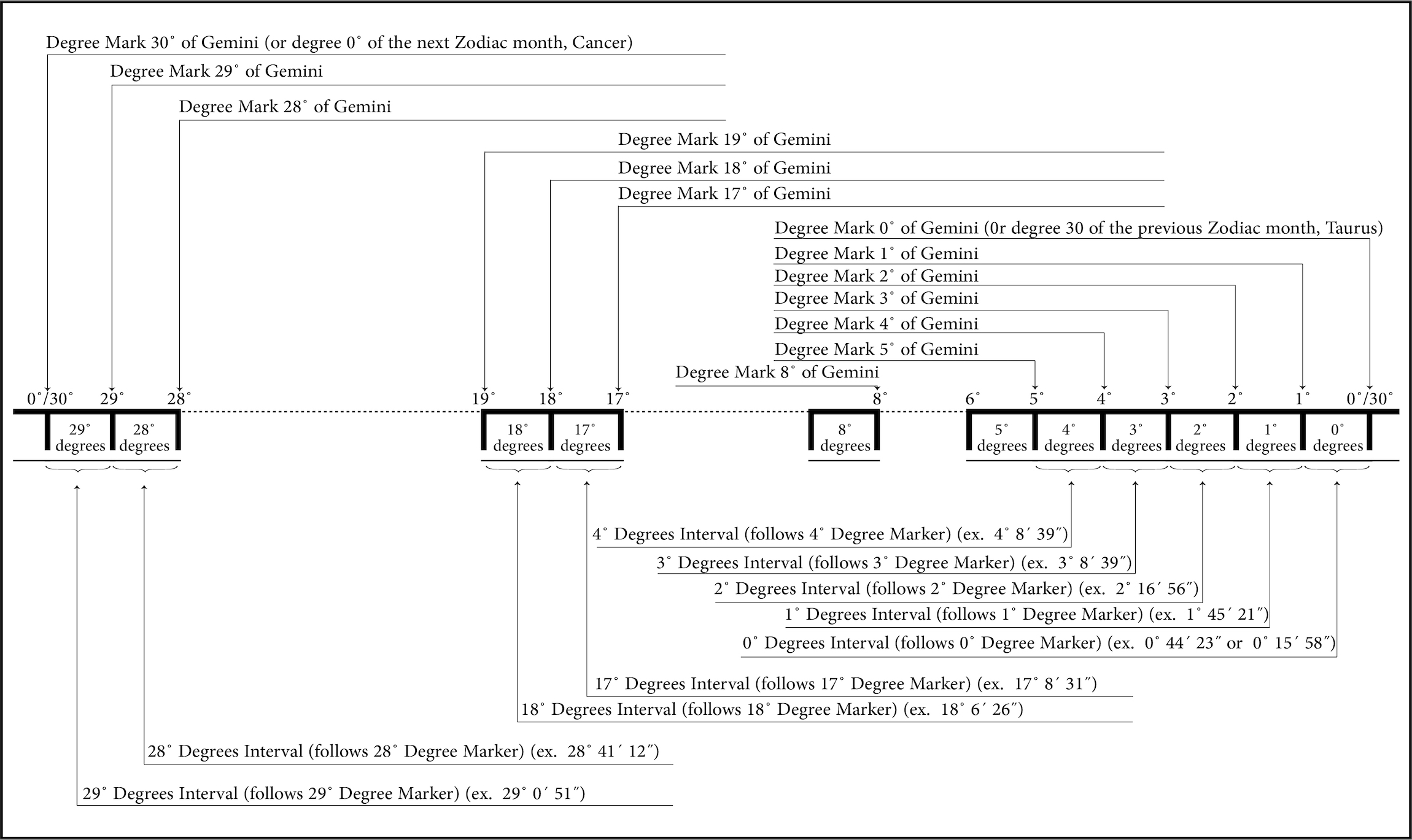
In astrology, the year, conceived as a circle, is divided into twelve Zodiac months, each consisting of 30 degrees, each of the degrees being comprised of 60 minutes, and each minute comprise of 60 seconds. The degrees refer primarily to the markers, each marker giving its name to the interval that begins with that marker. The first marker marks the 0˚ degree of the new Zodiac month, being at once also the 30˚ of the previous Zodiac month.
The first interval is called “0˚ degrees” interval, and the last interval of the Zodiac month is called “29˚ degrees” interval of that month. Online, you will nowadays find many discussing the topic of “critical degrees,” an expression used for the 0˚ and 29˚ degrees, since it is assumed, by those believing in astrology, that chart owners having planets falling in these intervals display mixed characteristics associated with the Zodiac signs preceding and following the intervals.
The reason the plural “degrees” is used is that it is assumed that any planet or celestial body falling in that interval would be on that degree (defined by the marker beginning its interval) plus the number of minutes and seconds that identify its location in that interval.
For instance, consider the Swiss Ephemeris Tables for the year 1000 for 50 years at https://www.astro.com/swisseph/ae50/ae__50_1000d.pdf. You will not find a 30˚ notation for any planet in the entire years, but you will find plenty of 0˚ and 29˚ degrees, if you search the pdf.
Therefore, anyone not versed adequately in the conventions and protocols of astrology (or not knowing how astrolabes or horoscopes are constructed and used), thinking that the first interval beginning the Zodiac month is its 1˚ degree, is bound to not appreciate the extent to which Tirtha was inconsistent in its Sun-Mercury Samimi (Cazimi) findings matching the “third degree” (or degree 3) requirement of Khayyam’s horoscope.
Tirtha justified his findings matching the “third degree” (or degree 3) requirement of Khayyam’s horoscope, because he was himself incorrectly applying the “third degree” definition requirement of the horoscope in his search for the birth date he was looking for. For instance, consider his statement below:
The Sun takes 63 days to complete the first 62 degrees [Indian Ephemeris, Vol. I], and was in the third degree of Gemini 63 days after 15th March, i.e., on 18th May. We thus know that ‘Omar was born at Sunrise on 18th May. (p. XXXIII)
What the first sentence clearly implies is that Tirtha considered the “first interval” to be degree 1˚, the “second interval” to be degree 2˚, and the “third interval” to be degree 3˚.
It is here that we can see how the mistranslated language “third degree” has not helped Tirtha, since, being unfamiliar with the conventions of counting the degrees, he has assumed that 62˚ represents the “third degree” (or degree 3) of Gemini, and this is clearly wrong.
In the chart found at https://www.astrology.scullywag.com/the-360-zodiac-degrees/ about “Zodiac Degrees” you can see that Gemini degree 3˚ is associated with degree 64˚ not 63˚, and Gemini degree 2˚ is associated with 63˚.
This is because, when trained astrologers (and astronomers in Khayyam’s time certainly also did) wish to give a degree address for an astrolabe or horoscope, they assume(d) universal and established protocols are being followed in identifying degree marker and its associated interval beginning with that marker. When Khayyam gives the address degree X in his horoscope, he is referring to the degree marker X and the interval that begins (not ends) with that marker.
To reiterate, intervals in Zodiac month degrees are named after the marker with which the interval begins, not ends. It is for this reason that in the “first interval” you have the 0˚ degrees (not anything attributed to the degree 1˚), and that is also why the last interval of the Zodiac month is 29˚ (not anything attributed to 30˚).
30˚ is only a marker, and does not have any associated interval following it, since it coincides with the 0˚ of the following Zodiac month. The interval beginning from it is therefore named after the 0˚ degrees of the new month.
So, here we find another evidence to realize that Tirtha was not well versed in the subject he was studying. As he had ignored the Julian/Gregorian calendrical distinction for the alleged birth date he had found for Khayyam, we find here that he had been counting his degrees wrongly, leading him to chase after a degree in the wrong interval of the horoscope map.
This explains why he never caught his own error, and why those following his lead uncritically in counting the degrees will commit the same mistake and not find Tirtha as being in error, because they themselves are also making his error.
In Book 2 I had assumed readers were familiar, or could familiarize themselves adequately, with the basic protocols of degree counting in astrology. That is why it had struck me as odd that Tirtha had claimed that his findings in the 62˚ were consistent with his reading of the Gemini degree number as being 3 in Khayyam’s horoscope. For all practical purposes, Tirtha had set himself the task of finding his degree solution in the wrong interval of the Zodiac wheel.
But, as I showed in Book 2, and will explain further below, neither in degree 2˚ interval being shared in his book as a 3˚ nor in the actual degree 3˚ interval of Gemini could he find a date that could fulfill Khayyam’s precise horoscope requirements.
Again, to repeat, to indicate precise locations of planets on the Zodiac wheel, Zodiac month degree numbers are assigned as markers, and the interval following each marker takes its number from that marker, that is, the marker with which the interval begins (not the degree marker with which the interval ends).
Each month begins with the 0˚degree marker (and its associated interval) of that month (that 0˚ degree marker being at the same time the 30˚ degree marker of the previous month).
The first interval of each month is where the 0˚ degrees appear, its second interval is where the 1˚ degrees appear, its third interval is where the 2˚ degrees appear, its fourth interval is where the 3˚ degrees appear, and so on. The last interval of each Zodiac month is its 29˚ degrees interval. There is no 30˚ interval in each month, since 30˚ is the last marker of that month, which is at the same time degree 0˚ marker of its next Zodiac month.
So, to reiterate yet again (see Figure I.2), a degree refers to a marker and the interval that begins with that marker:
0˚ degree marker of a New Zodiac month is at once 30˚ of the previous month
Its first interval (called 0˚ degrees interval) begins with marker 0˚
Its second interval (called 1˚ degrees interval) begins with marker 1˚
Its third interval (called 2˚ degrees interval) begins with marker 2˚
Its fourth interval (called 3˚ degrees interval) begins with marker 3˚ …
Its twenty-ninth interval (called 28˚ degrees interval) begins with marker 28˚
Its thirtieth interval (called 29˚ degrees interval) begins with marker 29˚
30˚ degree marker of the above Zodiac month is at once 0˚ of the next month
Tirtha’s findings for the position of the Sun and the Mercury as previously given do not fulfill even his own “third degree of the Gemini” reading of Khayyam’s horoscope, since 62˚ degrees fall in 2˚ (not 3˚) degrees interval of the Gemini.
However, as I explained in detail in Book 2 already, and in this chapter again in summary, it does not matter whether Tirtha counted his degree as “third degree” (even though it was degree 2˚) or that he had found a position on degree 3˚, since neither of those locations entirely fulfill Khayyam’s other horoscope requirements.
6) Do Tirtha’s Findings Fulfill the Horoscope’s Samimi (Cazimi) Requirement?
Let us go back and take for granted Tirtha’s degree findings for the Sun and Mercury, even though they do not fulfill his alleged degree 3˚ condition based on universally agreed upon way Zodiac degrees are counted.
Do the findings fulfill the Samimi requirement as clearly stated in the horoscope?
Here we encounter a verbal deception on the part of Tirtha in trying to pass his findings as fulfilling the Samimi (Cazimi) requirement.
As he has himself quoted from an Arabic dictionary (p. XXXII)—one that can also be found online today (searching for “kashaf estelahat olum”)—Samim refers to the feature of a planet being within 16 minutes of the Sun, also referred to as being “in the heart of the Sun,” as if having the ear of the king.
As I explained the term in Book 2, Samim or Samimi in Arabic means being intimate, as in being friendly, and Cazimi is a Latinized transliteration of Samimi. The definition is clear. It specifies the orb degree requirement as being 16 minutes.
There is nothing in the definition suggesting an approximation, such as “approaching” or “tending”—which are terms Tirtha simply makes up. For example, he states “Ṣamimi is thus tending to be Ṣamim” (p. XXXII), which is a deceptive way of conditioning the reader’s mind for later accepting his data for Mercury, ones that do not meet the Samimi (Cazimi) requirement of 16 minutes distance between the Sun and Mercury.
Tirtha’s text suggests that he was unaware that if Mercury falls outside the 16 minutes orb, astrologists have their own specific terms for them such as “under the beam” or “combust” (burned out), depending on the distance of Mercury beyond the 16 minutes and this has significant interpretive consequences for the birth chart’s owner.
It means the intellective powers of the birth chart owner are not amplified by the Sun, but “reduced” or even “burned out” due to the overwhelming radiations of the Sun when Mercury is not “at its heart.”
Tirtha’s verbal maneuver leads him to state “Mercury was tending to be Ṣamim, i.e., approaching towards the Sun so as to come within 16 minutes of an arc” (p. XXXIII). That is not what Khayyam’s horoscope says; it clearly expresses a Samimi feature.
In Tirtha’s dictionary source, Samim is (mistakenly) translated as “Combust” presumably since it implies what can happen if the 16 minute condition is not met. But Tirtha missed noticing even that distinction (for more information see https://en.wikipedia.org/wiki/Astrological_aspect).
He simply made up “Samimi means tending to be Samim” to preemptively answer his critics, since even his own figures for the Sun and Mercury do not fulfill a Samimi requirement, as explained below.
In his first try, Tirtha fails to even offer any specific degrees for the Sun’s position, other than being “on the third degree” (by which, we now know, he erroneously means between 2´ and 3´).
So, even assuming Mercury was at 62.7˚ (that is, 2˚ 42´) of Gemini, that does not imply automatically a Samimi configuration is present.
Yet, without even having given the Sun’s exact position, and not having yet shared his second or third tries, he declares having found a solution to the problem of determining Khayyam’s birth date. He states:
The only year when Mercury was in the 3rd degree of Gemini on 18th May is 1048. Thus the problem is solved, and we find that ‘Omar Khayyam was born at Sunrise on 18th May 1048. (p. XXXIV)
Now, being himself not satisfied with his first try, yet having declared the problem solved, he proceeds to his second try, this time offering more exact locations for the Sun and Mercury.
I will later discuss Tirtha’s methods used in his three tries, but taking them for granted for now, he reports 62˚ 23´, 62˚ 46´for the positions of the Sun and Mercury respectively.
But even his second try results are not evidently confirming the fulfillment of the Samimi requirement. In the second try, there is a difference of 23 minutes between the Sun and Mercury (46-23=23).
And using the now exactly given position of the Sun (62˚ 23´), the difference between it and the location of Mercury as reported in Tirtha’s first try is 19 minutes (42-23=19). So, even here Tirtha has failed to show his findings fulfill the strictly defined Samimi (Cazimi) requirement.
So, his second try, meant to “verify the solution by direct calculation of the positions of the Sun, Mercury and Jupiter according to their motions known to the Persians in those times” (Ibid.:XXXV) has in fact disproved the less exact findings of his first try, yet he deceptively passes it on as a confirmation of his first try.
But even Tirtha’s third try ends up not confirming his first and second try results. Instead they confirm—by way of, as he puts it, “modern astronomy recalculated according to the Modern Elements, the accurate positions of all the planets…” (Ibid.:XXXVII)—that some of his prior reported figures were indeed wrong.
I will later address the question of validity of his having used “ancient methods” in his second try, but here, in his third try, he is acknowledging that the accurate figures for the Sun and Mercury respectively were in fact 62˚ 20´ and 66˚ 25´. So the difference between their location was not even in minutes, but in degrees, that is, 4 degrees and 5 minutes.
That is way more than the required 16 minutes (16´) for Samimi (Cazimi) condition fulfillment. Had Tirtha waited until his third try to make his final decision regarding whether he had found a solution to the problem of determining Khayyam’s birth date, the numbers reported across all the three tries he made should have given a resounding verdict of rejection to his findings.
Strangely, when it came to drawing the birth chart for Khayyam (on page XXXVII), on the basis of which he (or rather, his consultant) intended to draw traditional astrological interpretations for Khayyam, the figure used for Mercury is not “the accurate” 66˚ position found by his consultant in the third try, but the presumably less accurate 62˚ plus figure reported in his first and second tries.
Besides, the location data given in the table of the third try (p. XXXVII), which are in fact most accurate, include those for Uranus, Neptune, and Pluto, planets that had not yet been discovered in Khayyam’s time.
This suggests that the astrological interpretation being undertaken was of the traditional kind, and not meant to explore what Khayyam himself would have thought of his own birth chart, which is a legitimate question to explore from a hermeneutic point of view as far as astrological interpretation of a birth chart goes.
And yet, even more oddly, the box of the birth chart shared on page XXXVII includes a mix of numbers that are different from the figures given in their more accurate table immediately above it (for instance, Jupiter’s position is given as 289˚ when in the table immediately above it, it is (more correctly) given as 307˚. All these again show the careless way Tirtha was handling his data.
How does Tirtha reconcile his non-confirming figures for the Samimi (Cazimi) condition requirement with the universal definition he himself quoted previously for it? From the beginning of his tries, he had deceptively begun to rephrase the definition of Samimi (Cazimi) in a way that would make his findings plausible.
This was done by way of introducing the notion of “tending” and “approaching” to the universally agreed upon definition of Samimi (Cazimi). For him, as long as Mercury was “approaching” the 16´ Samimi (Cazimi) distance requirement, that would be acceptable, and he found the notion of Mercury being “retrograde” an automatic confirmation that such an approachment would in fact result in the fulfillment of the Samimi (Cazimi) distance requirement.
For example in his second try, Tirtha states, “and the Mercury is in retrograde motion hence Ṣamīmī” (p. XXXV). But such a statement is evidence, again, for Tirtha’s lack of adequate knowledge about basics of astronomical, and astrological, motions as far as Mercury retrograde goes (a visual illusion from the Earth of Mercury reversing its motion direction, when in reality there is no such reversal).
As it can be observed at https://en.wikipedia.org/wiki/Apparent_retrograde_motion, especially in the helpful animation included for the year 2020 as an example, Mercury undergoes apparent retrograde motion three times a year, two times Mercury passing behind the Sun, and once in front of it, as viewed from the Earth.
The months and days of Mercury retrograde motion vary across years, but it can take approximately 21 days, less or more, for Mercury to be in retrograde, and it can take about 7 hours crossing the Sun. Mercury moving in retrograde does not always happen when approaching the Sun, but can happen moving away from the Sun.
Depending on where Mercury is located in the chart, it can take days or hours for it to reach the “heart of the Sun.” So, without investigating the degree locations of both the Sun and Mercury in a birth chart, there is no way one can conclude that Mercury being retrograde automatically translates into a motion approaching the Sun, or in a length of time that one wishes it to take place.
The trouble is this. If the Mercury retrograde motion is even approaching the Sun for a birth chart (one that has to be proven, and not assumed, since Mercury can be moving away from the Sun in retrograde as well), it can take days or hours to do so, and in the case of Khayyam’s chart, the condition of birth having taken place at sunrise, and on a particular day, would be undermined for that retrograde motion approaching the heart of the Sun (if that is indeed the case).
By the time the supposed Samimi requirement is met, in other words, it will likely not be at sunrise nor even the same day any more (the latter implying that the Gemini degree requirement of “third degree,” even erroneously considered, would not even be met).
Based on the Swiss Ephemeris data, in May 1048, the Sun-Mercury Samimi conjunction in Gemini took place starting on Friday, May 20, around 5:00 p.m., ending about 2 hours past midnight on Saturday, May 21 (closest points of which I have included in Table II.3 in Book 2, to be shared later as Table I.1), the ascendant degree not being in Gemini.
By the time the ascendant became Gemini, the Samimi conjunction had ended, so by sunrise of May 21, Mercury’s retrograde was moving away from the Sun. It seems that, once the cat is out of the bag, it is hard to put it back to meet all the horoscope conditions—at times the tale, at others the legs, the ear, or even the whiskers, still protrude.
The beauty of the puzzle Khayyam set with his horoscope is that all its precise conditions must be fulfilled in tandem.
Therefore, even using Tirtha’s erroneous degree findings for the Sun and Mercury, no matter which of his three tries we consider, its requirement remain unfulfilled. It is the deceptive “approaching,” “tending,” “Samimi means tending to be Samim,” and “retrograde motion hence Samimi” verbal maneuvers that are deliberately devised to mask his failure in achieving his goal.
7) Do Tirtha’s Findings Fulfill the Horoscope’s Ascendant Degree Requirement?
There is a feature of Khayyam’s horoscope that altogether escaped Tirtha’s attention and those of others whom I have read commenting on the birth chart. It has to do with what is called in astrology “the degree of the ascendant.”
Tirtha has of course noted the feature of Khayyam’s birth having happened at sunrise. However, he failed to mention that the sunrise time Khayyam was born at must be shown to have also fallen on the same degree X in which the Sun-Mercury Samimi (Cazimi) conjunction fell.
For the sake of comparison, I shared in Book 2 of the series (p. 47) the horoscope chart for Tirtha’s erroneous proposed date, May 18, AD 1048 Julian (corresponding to May 24, 1048 Gregorian) date for Khayyam’s birth.
It is based on the accurate Swiss Ephemeris data, and as it can be observed, the positions of the Sun and Mercury (and Jupiter) are nearly the same as the “accurate” figures Tirtha offered in his third try, data that proved the actual Mercury position was not on degree 2˚ nor 3˚ but 6˚ 27´—that is about 4˚ degrees 5´ minutes away from the Sun location 2˚ 22´. This is way beyond the required maximum 16 minutes (16´) expected of the Samimi (Cazimi) conjunction.
The reason I shared the chart therein is to draw the reader’s attention to the AS (ascendant) degree given for the time in the bottom left corner chart, which is 01˚ 38´. So, clearly this condition of the horoscope is also not met by Tirtha’s proposed erroneous findings.
Tirtha did not even offer this data to “verify” his findings, since he simply missed noticing this important feature of Khayyam’s horoscope. According to the precise statement, not only the Sun-Mercury Samimi (Cazimi) was on the degree X, but the Sun was rising on that degree as well.
This negligence is not only telling again of the limitations of Tirtha’s study of Khayyam’s horoscope and of his lack of awareness of the ascendant degree requirement, but that the horoscope was offering a highly nuanced and specific address for Khayyam’s birth date and time, a feature that is telling of the astronomical acumen and training of the person, that is Khayyam, who has passed on information about his birth date and time by way of his horoscope. He is telling us, “when I was born, the Sun and Mercury were Samimi, and the Sun was rising on the same degree at which they were Samimi.”
Tirtha entirely missed that point.
In Tirtha’s erroneously proposed date chart, the Sun, Mercury, and the Ascendant were each on three different degrees, none even being on the degree 3˚.
8) Do Tirtha’s Findings Fulfill the Horoscope’s Jupiter-Observing Feature Requirement?
There is yet another feature expressed in Khayyam’s birth chart that also escaped Tirtha’s attention amid his rushed, internally inconsistent, and factually inaccurate, tries to find Khayyam’s birth date.
It has to do with the last part of the horoscope where the Jupiter’s Taslees (Trine) with the Sun-Mercury Samimi is mentioned.
In Book 2, pp. 55-57, I explained this subtle feature. If you consider Tirtha’s proposed date’s birth chart, you can see that moving clockwise, it is the Sun-Mercury Samimi that is “observing” Jupiter in daytime’s chart from a shorter arc’s distance.
In contrast, in the horoscope, Khayyam is telling us that at his time of birth, it was Jupiter that was “observing” the Sun-Mercury Samimi through the short arc.
These subtle features have significant interpretive connotations in astrology, given that Jupiter is the major benefic planet, observing the also highly benefic Sun-Mercury Samimi conjunction.
Those familiar with astrological interpretations will find that in Beyhaqi’s reporting of Khayyam’s birth horoscope in Tatemmat Sewan el-Hekmat, he follows the statement by noting features such as strength in memory as a consequence of what is associated with the Sun-Mercury Samimi (Cazimi) feature in birth charts.
The same must be considered regarding the Jupiter observing the Samimi (Cazimi) conjunction statement. I have elaborated in these interpretive matters in Book 2 and especially in Book 3 of this series.
Jupiter “observing” from a night location the Sun-Mercury Samimi at sunrise is a coded message included in Khayyam’s horoscope; it pertains to the last leg of dazzling Triplicities featuring the chart, in astrology associated with the last third of the chart owner’s life.
Unfortunately, Tirtha missed noticing the significance of this feature, whose absence in his erroneously proposed birth date for Khayyam could have offered him another chance to disqualify his findings.
9) Tirtha’s Errors in His First Try
We should first note that Tirtha in his first try associated Zodiac degrees with calendar days. Zodiac year has 360 equal degrees. A calendar, varying in calendars, is usually regarded as having 365 days (not counting the leap years).
So, there is no way one can associate the degrees directly with calendar days. It happens that the Gemini is a third month in the Zodiac cycle, so the three degree markers in Gemini coincide roughly with three days, but this cannot be assumed for later Zodiac months.
Second, Tirtha uses “Indian Ephemeris” as his source. This is in reference to a specific series of books published in early 1920s by “Dr. Swamī Kannu Pillai” (p. XXXV). Pdf copies of his series can be found online on Internet Archive (https://archive.org).
In his series Pillai has offered his own system of calculating the position of planets across time, presumably drawing on ancient and modern sources. In his “Vol. I-Part I, General Principles and Tables,” there is not a single mention of Persia, Iran, let alone its ancient calendars. The only references are to “Muhammedan” (Islamic) lunar calendars in brief sections.
I will return to this issue when evaluating Tirtha’s second try, but at this point, it is important to note that there is nothing “Persian” about his methods or tables of calculation of planetary bodies.
Third, there is no reason to regard Pillai’s source as being “official.” Pillai had simply offered his own personal methods and tables, and while based on earlier sources, his system was published in early 1920s, about two decades before Tirtha’s work (1941).
There is nothing “official” about his source. When examining his series, you will find that he does not offer detailed data for motions of all planets, but for basic Sun and Moon reference points from which the motions of the planets can be calculated using his method.
In other words, if Tirtha draws on “Indian Ephemeris” as his source data, he is referring to how he (or his consultant, likely the person he later identifies as S. R. Subrahmania Shastry, p. XXXVII) calculated the position of Mercury for their chosen dates. As in any calculation, therefore, errors can be made that can explain discrepancies with data offered by others.
Fourth, since Tirtha does not offer exact page locations in the Pillai series from which his data for Mercury’s location on May 18, 1048, would be found or calculated, he has left us with a claim that is not verifiable, which is a requirement of any reasonable and scientific evaluation.
But, what we do know is that in his first try Tirtha shares a location for Mercury, that is, 62.7˚ (or 62˚ 42´), that is in error in comparison to his own (correct) data he later shares in his third try (66˚ 25´).
So, we can claim to have a reasonable doubt, based on Tirtha’s own data across his tries, that there is something wrong with the methods of Pillai’s calculation for Mercury.
Fifth, note that in his first try, Tirtha is not claiming to have used any ancient Persian ephemeris of methods of calculating the planets. He is using Pillai’s system, published just two decades earlier, and his system is leading to a wrong address for Mercury on May 18, 1048, Julian.
As noted earlier, Tirtha does not offer any exact degree location for the Sun in his first try, so we have no way of scientifically judging the accuracy of Pillai in this regard. But there is something wrong with Pillai’s system that is resulting in a wrong address (almost four degrees off) for Mercury.
Sixth, oddly, Tirtha does not problematize or even comment specifically on the discrepancy across the location degrees he reports across his first and third tries (when he acknowledges the latter to be more accurate, which is). He simply ignores where the “verifications” he claims to be making should make a difference.
He could even comment on the matter and explain and justify why still the Pillai-derived Mercury address of 62.7˚ (or 62˚ 42´) in his first try should be the basis. But he chooses to simply ignore the discrepancy.
And this is especially important for Mercury because its Samimi (Cazimi) conjunction with the Sun is a central feature of Khayyam’s horoscope being studied to determine his birth date.
Again, note that in his first try Tirtha has not entered at all into the consideration of what “ancient Persian” systems would say about Mercury’s or other planetary positions.
In his first try, Tirtha is using a reference source from just two decades earlier, and his data that has been derived based on that “Indian Ephemeris” contradicts the accurate address he himself gives for Mercury, finally, in his third try. Therefore, it really does not matter how exactly he (or his consultant) calculated Mercury’s position in their first try.
The resulting figure is wrong, casting doubt on the reliability of their source: Pillai’s 1920 published “Indian Ephemeris.”
Seventh, Tirtha has made other errors. Why can we be sure he and his consultant themselves have not made errors in calculating Mercury’s position in their first try?
The resulting wrong address for Mercury may even be a result of errors Tirtha and his consultant have made using Pillai’s data and methods, the latter not being necessarily at fault.
How can we know he used Pillai’s method correctly to find Mercury’s position in his first try?
There is therefore reasonable doubt about the reliability of Tirtha’s claim for Mercury’s address in his first try, when compared with his own reported accurate data in his third try.
10) Tirtha’s Errors in His Second Try
Tirtha’s verbal maneuvers of going about searching for Khayyam’s birth date in his second try are so astonishingly erroneous that require their own hermeneutic analyses to fathom why he resorts to such deceptive means.
In order to understand why Tirtha resorts to a second try, and indeed even his first try, in solving the puzzle posed by Khayyam’s reported horoscope, we need to consider the following.
Tirtha began with a wonderful idea of discovering the birth date of Khayyam by solving the problem or puzzle posed by his reported horoscope.
However, in doing so he faced a dilemma. His manuscript source, an image of which he even provided in his book (1941: image following page XXXII), was leading him to read the Gemini degree as being 8˚ in its abjad expression, but that degree was in no way resulting in a birth chart configuration fulfilling the rest of Khayyam’s horoscope.
So, he and his consultant must have thought that the degree must instead be a “third degree” of Gemini, not 8. In searching for that degree’s possibilities, he and his consultant (“well-versed in the ancient as well as modern astronomy,” p XXXVII) could not even read the degree correctly according to the alphabetical basics of astrological definitions and conventions, and simply took for granted that it must be somewhere in the Gemini degree 2˚.
I doubt that they even tried the actual degree 3˚, since, had they tried it, they may have found the Mercury being closer to the Sun, but still way too distant from it still in degrees to even “approach” Samimi (Cazimi) features.
Having tried looking into the Gemini degree 2˚ possibilities using the “modern” means and “most accurate” data that they actually reported in their third try, however, they were disappointed to find that Mercury was not minutes, but four degrees, away from the Sun.
It did not matter if Jupiter’s position fulfilled the requirement or not (which it generally did as far as the degree locations are concerned, but not regarding other “observation” aspects of the subtle requirements posed by the horoscope).
Mercury must be close enough, they must have thought, at least “tending” or “approaching” the Sun closely enough, for the degree 2˚ solution to make any sense. So, what to do?
It was then that they concocted the scheme that it did not matter if their “modern” astronomical data fulfilled the horoscope requirement, but what really mattered was the data that had been available to Khayyam (or those in his times going back to when he was born).
So, Tirtha must have concluded that he must somehow use the astronomical data available to “Persians” around Khayyam’s time in order to find out when he was born, based on the reported horoscope.
Generally speaking, that is in fact not a bad idea, since obviously Khayyam who reported his horoscope to others must have come up with the formulation of his horoscope based on the astronomical data he had available in his time.
But, approaching the problem that way posed its own challenge and new puzzle. How can Tirtha and his consultant (versed in “Indian Ephemeris” and familiar with the Pillai system just published two decades earlier) could solve this new problem?
The problem was that, as Tirtha put it himself, the current ephemeris at the time of Khayyam or soon thereafter, namely the Malekshahi ephemeris or Sanjari ephemeris were “known in name only” (p. XXXV), meaning they were not extant to be used for the purpose.
The next best option, they thought then, was to rely on the Ilkhani ephemeris, that came about two hundred years later than Khayyam’s time, a copy of which was available to them in Heyderabad (p. XXXV).
They found that this manuscript, “contains tables for computing the positions of planets for a hundred years commencing from first noon of the Yazdgerdi year 601” (ibid.); that first day, they added, fell on 16th June 632 A.D. (ibid, in Julian presumably).
So, using the methods of calculation they learned from the manuscript of the Ilkhani ephemeris (“Zich-i Ilkhani”), they calculated where the positions of the Sun, Mercury, and Jupiter would fall on May 18, AD 1048.
I will trace their calculation later below, but to briefly note their result here, they ended up with location degrees for the Sun, Mercury, and Jupiter that seemed (to them) to be acceptable for fulfilling the horoscope requirements.
But they still had to explain why these findings contradicted the modern data about, in particular, Mercury’s position, according to which Mercury was degrees away from the Sun.
Here, they realized that finding a matching with what they ended up reporting as their first try, using Pillai’s methods, can be validating for their efforts, since, they could argue that the first try Pillai methods more or less confirmed their findings in their second try.
What tied the first try and second try together was Tirtha’s claim that “Persians” had used the same ancient sources as Pillai had done, so it was justified to consider that the results of their first and second tries confirmed one another. For example, read this passage in Tirtha (p. XXXV):
The above solution was obtained from the Tables in Ephemeris, prepared from the beginning of the Kaliyuga (3101 B.C.) to 2000 A.D. by Dr. Swami Kannu Pillai, on the basis of Ārya Bhatta and Sūrya Siddhānta known to the Persians as Ibn-i Baṭūta’ and Sind Hind! I felt it necessary to verify the solution by direct calculation of the positions of the Sun, Mercury and Jupiter according to their motions known to the Persians in those times.
The Zich-i Malik Shahi by ‘Omar Khayyam and Zich-i Sanjari by ‘Abdul Rahman Khazin being known in name only, the next in time comes Zich-i Ilkhani by Nasir ud Din Tusi (d. 1259). The MS. of this [SML. Hyderabad] contains tables for computing the positions of planets for a hundred years commencing from first noon of the Yezdijardi year 601.
In other words, Tirtha’s first and second tries were mutually confirming because Pillai and “Persians” had allegedly relied on the same sources for their calculations.
Before we examine Tirtha’s second method more carefully, let us untangle the logical web he weaves in his verbal maneuvers to justify his way of going about finding out how “ancient Persians” themselves (presumably Khayyam himself) would have arrived at formulating the ephemeris conditions of the horoscope.
To understand the web, we in fact need to read his tries backward, starting with his third try moving back to the second and his first tries.
Having realized that modern ephemeris data do not fulfill the horoscope’s Samimi (Cazimi) condition at all for 2˚ degree interval (erroneously called by them “third degree”), given the four degrees plus separation between the Sun and Mercury, Tirtha had to convince his audience that the ephemeris data and calculation methods of ancient Persians did fulfill the conditions.
But the ephemeris data devised during Soltan Malekshah and Soltan Sanjar (closest to Khayyam’s time) not being extant at the time, he used the centuries later coming Ilkhani ephemeris data and methods instead claiming that generally speaking ancient Persian and recent Pillai ephemeris data methods had common sources.
Therefore, if the second try confirmed the first try, that is sufficient to solve the problem of the horoscope by way of the ancient times’ own data and methods as, presumably, must have been the same methods that Khayyam (or his contemporaries) used to define the horoscope.
The problem with Tirtha’s way of going about basing his study of Khayyam’s horoscope on the ephemeris data and methods of his time are the following:
1.
Tirtha does not and cannot provide any evidence at all that any of the sources he has relied on to find out how “ancient Persians” would have gone about formulating Khayyam’s horoscope are in fact those used by Khayyam’s contemporaries and especially Khayyam himself, since, as he admitted neither the Malekshahi nor the Sanjari5This writing (not an ephemeris) actually has now become extant, for which see here: https://archive.org/details/TheZijAs-sanjariOfGregoryChioniades/page/n81/mode/2up ephemerides were extant for him.
2.
Tirtha’s second try is only, and only, an effort in the verification of his conjectured date resulting from his first try (May 18, 1048, Julian). It is not a survey of all the possibilities using the alleged ancient method. This means, Tirtha has not proven in his second try that there were other dates (using the alleged “ancient method”) that were not more fulfilling of the horoscope requirements than the one he had found in his first try.
In any case, neither the first try findings nor the second try findings show the existence of a Sun-Mercury Samimi (Cazimi) configuration. Verbal acrobatics of “approaching”/“tending,” Samim/Samimi, or “retrograde hence Samimi” are neither convincing nor valid in proving the existence of a Samimi (Cazimi) requirements.
Khayyam’s horoscope is very precisely stated and very clear. The Sun-Mercury Samimi conjunction was on the same degree of the ascendant, degree X (3˚ according to Tirtha) of Gemini. Tirtha’s findings neither fulfilled the degree 3˚ of Gemini feature, nor the Sun-Mercury Samimi (Cazimi) condition, nor their being on the same degree of the ascendant.
Tirtha and his expert consultant had altogether even missed realizing the significance of the ascendant degree requirement. They also missed realizing the significance of Jupiter observing the Sun/Mercury Samimi (and not the other way around) feature in the horoscope.
3.
The horoscope being examined is not a horoscope of just another person. It happens that its owner was the most accomplished astronomer and mathematician of his time, highly trained and informed of the most intricate rules of traditional astrology as well, whether critically regarding them or not.
He is credited with the capacity and skills for calculating one of the most precise solar calendars. He was for 18 years in Isfahan, heading a team of scientists and experts, and was equipped with the state-of-the-art astronomical tools of his time, tasked with establishing and running an observatory in Isfahan.
He may not have had, regrettably, a chance to observe the skies for the 30 years needed for the outer plants, Saturn and Jupiter, but had plenty of time, year after year, to measure precisely the movement of other planets, including Mercury, and had a personal interest in doing so.
As done by all astronomers, he must have developed his own way of calculating the planets’ movements over time, based on 18 years of direct observation of their movements. Personal interests must have motivated him to even more carefully calculate his own horoscope backward in time.
His horoscope is precise, with specific features that cannot be accidental jotting down of notes. The Jalali and Sanjari ephemerides reportedly improved on all the methods, including from Indian sources, that had informed their own as sources.
It is simply unscientific and speculative for anyone to claim that by adopting and applying Pillai’s Indian methods (whose accuracy itself is questionable), or methods discussed by Ilkhani ephemeris two centuries later, one can be sure that their calculations were as precise as the observations made, based on 18 years of direct study by, Omar Khayyam himself, a master astronomer and mathematician of his time.
We are studying not just anybody’s horoscope from that time, for which reliance on other calculation methods would be necessary. We are studying the horoscope of a master astronomer and mathematician, who knew his alphabets of how degrees should be counted in astrolabes and birth charts, what the degree of the ascendant is, what Samimi (Cazimi) is, and what significance there is in Jupiter observing the Sun-Mercury Samimi from Trine aspectation, rather than the reverse.
11) Tirtha’s More Errors in His Second Try
In his first try, Tirtha did not offer any specific data for the location of the Sun in his wrongly presumed “third degree” 2˚ of the Gemini. He also did not offer any specific page references from the “Indian Ephemeris” (that of Pillai published in early 1920s), as to how he calculated Mercury’s position for the year AD 1048 as being 2.7˚ (or 2˚ 42´) of Gemini.
So, unfortunately, we do not have any way of evaluating and ascertaining whether he applied Pillai’s methods correctly for his Mercury position calculations. All can make mistakes, and we have seen many errors committed by Tirtha already, inadvertently or not.
He chose to read an abjad letter that clearly has the numerical value of 8˚ as being 3˚, and even then, he did not count the degrees correctly, finding 2˚ to be the “third degree” of Gemini—and the list of errors continues.
Why should we be sure that he had read the numbers in his Ilkhani ephemeris source correctly, given they are entirely rendered in abjad letters6For an image of the manuscript pages, see here: https://www.invaluable.com/auction-lot/nasir-al-din-al-tusi-d-ah-672-1274-ad-zij-i-ilkha-13-c-c9843c8bd4?srsltid=AfmBOoruO_25lvOdWoFOPiNLIm8so9e6XIMPC5KEGOpojZW-hCu6VEUg?
Thankfully, however, in his second effort, Tirtha offered the locations for the Sun, Mercury, and Jupiter to be respectively as follows: 62˚ 23´, 62˚ 46´, and 303˚. Besides, thankfully again, he also offered some tables to show how he went about calculating the positions of each, using the Ilkhani ephemeris methods.
So, let us examine the second effort Tirtha makes in his The Nectar of Grace to verify his claimed solution by conducting another calculation based on direct consultation with the “Zichi-Ilkhani” (Tirtha 1941:XXXV-XXXVI).
The question may be asked as to why Tirtha reported a wrong degree coordinate for Mercury in his second try calculations. If we consider more carefully his calculations as reported in the three tables for his second try, we find another error in Tirtha’s efforts at confirming his proposed birth date for Omar Khayyam.
Although what follows does not affect or explain our conclusion above that the Tirtha’s own second try calculations itself failed to confirm the position of Mercury for being in a Samimi (less than 16 minute) distance from the Sun, it does point even more to the susceptibility of Tirtha’s calculations to errors.
To understand how Tirtha further committed calculation errors in his secondary efforts at confirming his proposed birth date for Omar Khayyam, we need to read his words more carefully, as quoted below:
… I felt it necessary to verify the solution by direct calculation of the positions of the Sun, Mercury and Jupiter according to their motions known to the Persians in those times. The Zich-i Malik Shahi by ‘Omar Khayyam and Zich-i Sanjari by ‘Abdul Rahman Khazin being known in name only, the next in time comes Zich-i Ilkhani by Nasir ud Din Tusi (d. 1259). The MS. of this [SML. Hyderabad] contains tables for computing the positions of planets for a hundred years commencing from first noon of the Yezdijardi year 601.
The period from first day of the Yezdijardi era (16th June 632 A.D.) to the epoch of Zich-i Ilkhani is thus 290,000 days 12h. The period from 16th June 632 A.D. to the Sunrise [4h. 48m. A.M.] of 18th May 1048, the date of ‘Omar Khayyam’s birth as previously found, is 151,915 days 4h. 48m. The difference is 67,085 days 7h. 12m. or 183 Yezdijardi years 290 days and 7h. Calculating backwards from the elements of motions given in the Zich-i Ilkhani the positions of the Sun, Mercury and Jupiter are respectively 62 23´, 62 46´ and 303˚ respectively, and the Mercury is in retrograde motion hence Samimi and Jupiter in exact triangulation as stated by Baihaqi. … (Tirtha 1941:XXXV)
Let us reconstruct Tirtha’s effort and calculations above.
In his second effort to arrive at another path of calculating the positions of the Sun, Mercury, and the Jupiter for his solution date May 18, 1048 (Julian), 4:48 am, Tirtha considered three other sources compiled by “Persians themselves,” only one of which was at the time available (the other two lost), according to him.
This is one complied by Nasir ud Din Tusi (d. 1259) (ibid, XXXV), according Tirtha, known as the Zich-i Ilkhani, which in his view offers positions of planets for a hundred years from the first noon of Yazdgerdi year 601.
Tirtha wished to calculate the years between the beginning (first noon) of the Zich-i Ilkhani’s 601st Yazdgerdi era year back in time to his discovered date of May 18, 1048 (Julian), 4:48 am, and do so based on the Yazdgerdi years for which planet positions are known in his source and available for 100 years beginning in the Yazdgerdi year 601.
Since the 600 years are in Yazdgerdi years, he had to find a way of calculating his proposed Khayyam birth date relative to the Ilkhani calendar so that he could use the methods of the latter to find planetary positions using the Ilkhani methods.
The Yazdgerdi calendar did take account of leap years, but did so every 120 years, so there was a tendency for leap years not to be counted and for the calendar to fall behind (as acknowledged also by Khayyam in his Nowrooznameh).
This is the reason a more timely, four-year, cycle became preferred in solar calendrical reforms (visit http://amordaden.blogfa.com/post/386 for a brief explanation of the average 365.25 length of the Yazdgerdi year across time, including the leap years).
For this, Tirtha needed to find two figures and subtract one from the other.
First, he needed to find out how many days have passed since the beginning of the Yazdgerdi Era to the supposed date of Omar Khayyam’s birth. Since he took the date June 16th, 632 A.D., as the former date and May 18, 1048, 4:48 am, date as the latter, the difference is 1048-632=416 years minus a number of days and hours because of the difference between May 18 and June 16 and the given hours.
This basically resulted in 416 years (103 of them leap years) minus 28 days plus 4 hrs and 48 minutes. This yielded the total number of days (416 × 365 days, amounting to 151,840 days, plus 103 accumulated leap-year days, minus 28 days from May 18 to June 16, equaling) 151,915 days plus 4 hr. 48 m., figure which he has given correctly in the text. So, that many days and hours have passed since the beginning of the Yazdgerdi era until his proposed birth date of Khayyam.
Now, Tirtha wished to calculate the number of days from the beginning of the year 601 of the Yazdgerdi era back in time to his proposed birth date and time of Khayyam. Note that the Yazdgerdi era begins on June 16, 632 AD, according to Tirtha. By the beginning of the year 601 of that era (which would be past the proposed date of Khayyam’s birth), he reports that 290,000 days would have passed.
Here, a series of errors are evident in Tirtha’s calculations which are partly typing errors and partly grave errors in calculations themselves.
In his text, when he is reporting the difference between 290,000 days 12h. and 151,915 days 4 h. 48m, an error is evident. The difference he reports between the two is “67,085 days 7 h. 12 m. or 183 Yezdijardi years 290 days and 7 h.” (Tirtha 1941:XXXV).
This would be obviously an error, since the difference between the two figures he has given of days 290,000 and 151,915 (for now not counting the hours) is 138,085, which is much more than Tirtha’s reported 67,085 days difference.
However, this error seems to be a typing mistake related to the reported 290,000 days for the 600 years and 12 hrs.—the hours adjusting for the beginning of the first noon of the Yazdgerdi year 601 which Tirtha has mentioned—than a matter of correctly calculating the differences.
It appears that Tirtha meant to write 219,000 rather than 290,000. 600 years (that is, before the first noon of the year 601) × 365 days yields the figure 219,000 for the number of days. When we subtract the 151,915 days 4h. 48 m. (to Khayyam’s proposed birth date) from 219,000 days and 12 hrs., we arrive at the figure 67,085 days 7 hrs. 12 m., as given by Tirtha.
He translates this time into 183 years and 290 days and 7 hrs. (183 × 365 which is 66795, plus 290 days, amounting to 67,085 days, plus 7 hrs. and presumably 12 minutes, the latter having been left unmentioned by him), which is then used as a basis for “calculating backwards” the motions of the Sun, Mercury, and Jupiter, from the data given for the first noon of the Yazdgerdi year 601.
Notice, however, that now another more serious substantive (not typing) error has occurred in Tirtha’s calculations. He has failed to count the leap years for the 600 years 12 hrs., and he has also made the same error when translating the difference of 67,085 days into years, since he has used the year of 365 days, not counting leap years, in arriving at his years plus day figures which are then used for his Sun, Mercury, and Jupiter position calculations. It is inconsistent to account for leap years in some periods, but not account for it in other periods for his calculations; after all the Ilkhani calendar took account of leap years, so did Khayyam.
Besides, if he wished to use (so speculatively) the Ilkhani calculations as if they could stand for what Khayyam used, calculating leap years would have to be a must, since Khayyam obviously was well aware of leap years in calendrical considerations.
If we count the leap years, we will come up with the following numbers:
A. For the 600 years 12 hrs from the beginning of the Yazdgerdi calendar: 600 × 365.25 = 219,150 days and 12 hrs, corrected from Tirtha’s 219,000 days by adding 150 leap-year days.
B. For the period between the beginning of 16th June 632 A.D. to Khayyam’s proposed birth date at 4:48 am on May 18, 1048, the figure reported by Tirtha and also confirmed by our evaluation above is correct since it does take account of the leap years: 151,915 days 4 hrs, 48 minutes.
C. If we subtract B from A, we arrive at 67,235 days 7 hrs. 12 min. This would translate into 184 years (now also counting leap years, which means dividing the day 67,206 days figure portion of 67,235 days by 365.25=184) plus 29 days 7 hrs. and 12 minutes. So, the breakdown in his tables must be for 100 years, 84 years, 29 days, 7 hrs. (and the missing 12 minutes7Note that the latter hourly “minutes” is different from the Zodiac “minutes” when counting Zodiac month degrees; since a degree in Zodiac month roughly represents a day, a Zodiac minute would be equal to 24 (hourly) minutes, or conversely a Zodiac minute would equal to about 1/24=2.5 hourly seconds. So, 12 hourly minutes roughly represents a negligible half of a Zodiac minute.—not 100 years, 83 years, 290 days, and 7 hours.
What this means is that the calculations Tirtha made in his second try are based on inaccurate figures due to his error and we have to recalculate Tirtha’s table figures using the correct numbers. However, since we do not have access to the manuscript source of figures, we remain in reasonable doubt regarding his data.
What we do know is that the resulting figures for the Sun, Mercury, and Jupiter will have to be different than the ones he has claimed to have “accurately” calculated.
Looking at his second try positions compared to the accurate degree positions finally reported in the third try (based on “modern” means), it is notable that there is a 4 degree difference in each of the positions for Mercury and for Jupiter between the two effort findings.
In his second effort, Tirtha offered the locations for the Sun, Mercury, and Jupiter to be respectively as follows: 62˚ 23´, 62˚ 46´, and 303˚. In his third reporting, Tirtha reported the following respectively for the locations of the Sun, Mercury, and Jupiter: 62˚ 20´, 66˚ 25´, and 307˚ 1´. The Sun location remained close, but the Mercury and Jupiter planet data are nearly 4 degrees off, similarly, across the two tries.
This can either be explained by calculation errors (as exemplified above regarding leap year calculations) on the part of Tirtha and his consultant, or it may be the case that the Ilkhani manuscript may have been misread, or even due to errors in the Ilkhani methods.
It is noteworthy that it has been observed that “The planetary positions of the Zij-i Ilkhani, derived from the zijs of Ibn al-A’lam and Ibn Yunus (10/11th cent. AD), were so faulty that later astronomers, such as al-Wabkanawi and Rukn al-Din al-Amuli, criticized it severely.”8See: https://en.wikipedia.org/wiki/Zij-i_Ilkhani
Another observation can be made as follows. Tirtha’s third try figures for the Sun, Mercury, and Jupiter are actually correct. The relative distance positions of the three bodies is, therefore, known.
Why is it that in Tirtha’s supposed “ancient” methods, or even that of his favored Pillai system used in his first try, the positions of Mercury and Jupiter are off 4 degrees, but not so for the Sun as well?
Where the ancients and Tirtha’s Pillai (or latter’s Indian sources) looking at a different sky above? Should not the Sun be also 4 degrees off in the second try calculations to suggest that they were considering the same sky for their measurements?
I think this observation casts further doubt on Tirtha’s purported “ancient” method calculations.
We also should keep in mind that the Ilkhani ephemeris came along two hundred years after Khayyam’s time, so there is no way anyone, including Tirtha or his expert consultant, or those following Tirtha’s lead nowadays, can claim that they were using methods that were the same as those used by Khayyam.
Tirtha’s verbal maneuvers of using Ibn Battuta’s name (who lived in the 14th century, hundreds of years after Khayyam’s death) is also glaringly displayed here. It is not only unscientific, but also sophistic, to equate all “Persian” ephemeris traditions as if they were the same, blaming Khayyam’s horoscope’s alleged approximations on miscalculations of the Ilkhani effort made more than two centuries later.
12) Tirtha’s Odd Birth Chart Figures
Having finally offered the accurate “modern” locations for the Sun, Mercury, and Jupiter in a table on p. XXXVII—that is, 62˚ 20´, 66˚ 25´, and 307˚ 1´, respectively, locations that clearly ruled out any possibility of a Sun-Samimi (Cazimi) configuration for his proposed solution—Tirtha, aided by his consultant, decided to engage in a traditional astrological interpretation based on their (erroneous) findings. But this effort itself is quite odd and inconsistent at its face value.
Obviously, now their intention was to interpret Khayyam’s chart based on what they had finally agreed to be Khayyam’s supposedly true chart figures. Their goal was no longer that of trying to see how Khayyam would have interpreted his own chart, of course, since their own table and its following birth chart includes Uranus, Neptune, and Pluto, planets that had not been even discovered in Khayyam’s time.
They even made references to the latter planets in their interpretation, so, obviously the interpretation intended to be based on the accurate figures they list in the final table on page XXXVII.
However, we find in their birth chart box the locations of the Sun, Mercury, and Venus to be 62˚ (when in their accurate table just above it, they differ, being respectively 62˚ 20´, 66˚ 25´, and 65˚ 39´).
Tirtha and his consultant had not given any location for Venus before, so, here we find them not even stating on the birth chart the location they share in the table preceding it. Even Jupiter is 289˚ now, rather than the location 307˚ 1´ in the table.
The same difference is observable even for the locations of Pluto, Uranus, and Neptune, Mars, Saturn, and to some extent the Moon. So, it does not appear that the birth chart based on which they wanted to make their “remarkable” traditional astrological interpretations followed the accurate figures they had themselves finally shared on that page.
This also raises the question whether the presumably more accurate data given on that table can be applied to the findings of their previous tries.
Why should someone use, for example, the daily motion of Mercury given on that “modern” table, one in which Mercury is four degrees away from the Sun, to justify the supposedly retrograde “approaching” of Mercury located closer to the Sun, but still not close enough, as reported in their earlier findings?
Those who may change their minds from expectations of days to hours of that eventful “approaching” must also reckon with the fact that retrograde Mercury can in fact be moving away from the Sun, not necessarily “approaching” it, and even so it would be at a time that obviously would not be at sunrise any more, when the need for the degree of the ascendant condition being the same as the Sun-Samimi Cazimi must also be met, of course.
13) How and Where Russian Scholars and Astronomers Went Wrong In Evaluating and Confirming Swami Govinda Tirtha’s Mistaken Date of Birth for Omar Khayyam
I share below my comments on this question as reported in Book 2 of this series.
An important factor that served to “officially” establish Swami Govinda Tirtha’s mistaken “discovery” of Khayyam’s date of birth and (to an important extent, indirectly) his date of passing (whose topic I discussed in Book 2 of this series), was the confirmation it received later from the Soviet Russian scholars and astronomers, obviously all done with good intentions.
In their important contributions published in 1962 compiling and commenting on most of the various extant manuscripts of Omar Khayyam9Rozenfeld, Boris Abramovich, and Adolf Pavlovich Iushkevich. 1962. Traktaty [Tracts or Treatises] of Omar Khayyam [Treatises of Omar Khayyam – In Russian with reproductions of original sources on Khayyām]. Moscow: Izd. Vostochnoi Litery., the Russian scholars Boris A. Rozenfeld and Adolf P. Iushkevich reported in their introduction an effort they made in evaluating Tirtha’s findings, in part by consulting their Russian astronomer colleagues for the purpose.
In doing so, they ended up confirming Tirtha’s proposed date for Khayyam’s birth date, while differing with the year Tirtha had proposed in 1941 for Khayyam’s date of passing.
They still used Tirtha’s proposed month and day (12th of Muharram) to offer their own preferred date for Khayyam’s passing on Dec. 4th, AD 1131. In a way, we can safely argue that the current uneasy world consensus dates for Khayyam’s birth and passing (May 18, AD 1048, and December 4, AD 1131), building on Tirtha’s work, originated from Soviet Russian scholars and astronomers who gave their official stamp of approval to them.
However, in light of my findings in Book 2 and further summarized and discussed in this chapter, it is now rather quite easy to understand how the Russian scholars and astronomers went astray in their mistaken confirmation of an erroneous birth date for Omar Khayyam.
This can be verified by directly accessing the introduction to their Moscow edition, its pages 16-21, where Rozenfeld and Iushkevich explain their effort as part of their introduction to their collection.
Recently, a Persian translation10مظفرزاده، باقر (مترجم). عمر خيام: زندگى و آثار. نويسندگان: باريس آبراموويچ روزنفلد و آدولف پاولوويچ يوشكيويچ. تهران: شركت انتشارات علمى و فرهنگى. ١٣٨٣، چاپ دوم ١٣٩١. of their introduction was published in Iran by Baqer Mozaffarzadeh, whose translations are well made in a short book comprising the Russian scholar’s introduction (only). But even the Russian original text can also be nowadays read by non-Russian speakers using online translation tools.
The explanation for the errors Russian scholars and astronomers made in their evaluation can be briefly offered as follows.
First, all their efforts at evaluating Tirtha’s findings were based on the mistaken assumption Tirtha made in reading the degree of Gemini in Khayyam’s reported horoscope as a “3.” They simply took for granted, uncritically, what Tirtha had wrongly determined to be the Gemini degree.
So, any efforts the Russian scholars and their astronomer consultants made to evaluate in order to confirm (or not) Tirtha’s findings were actually focused on reading the Gemini degree in the horoscope as 3.
The Russian scholars and astronomers were not exploring any other possible Gemini degree and its associated date(s). I have already explained in detail why neither 3 nor 8 degrees would result in finding a date of birth for Khayyam on which all the (other) requirements of Khayyam’s horoscope in tandem could be met.
Second, however, there is another important error, “lost in translation,” so to speak, that explains why the Russian scholars and astronomers failed in noticing otherwise glaring inconsistencies and inaccuracies in Tirtha’s efforts and catching his mistakes. Or, perhaps they did notice, but let it go, as I will further explain below. Actually, it is an odd error they made, but nevertheless it is quite interesting to note.
Even though in Tirtha, there is clearly an effort made by him to notice and consider the Samimi (Cazimi) requirement in Khayyam’s horoscope, where he even consults dictionaries to define what Samimi (Cazimi) requirement entails, that is the distance (in this case between the Sun and Mercury) should not exceed 16 minutes, in the Russian introduction (by Rozenfeld and Iushkevich), the word was translated, even in the supposed statement of the horoscope, as simply “conjunction” (in Russian, the word is соединении, one which Mozaffarzadeh, in this case correctly, since he was just translating from Russian, translated into مقارنه or “moqāreneh” in Persian astrological terms, which has the same meaning as “conjunction”).
Unfortunately, the Persian translator did not notice and comment (in a footnote perhaps) this discrepancy with Beyhaqi’s originally reported horoscope for Khayyam, but for this error, the translator was not at fault, the Russian scholars were.
“Conjunction” considerably loosens the requirement of the Sun-Mercury distance to such an extent that even one or a few degrees may suffice for the horoscope condition to be met, but the Samimi (Cazimi) requirement is much more strict, precise and a much narrower requirement to meet. It is about 16 minutes, which is just a bit more than a quarter of a degree.
In fact, even though Tirtha nominally acknowledges Samimi (Cazimi) as a requirement in Khayyam’s horoscope, he never offers any facts that convincingly supports the notion that his findings meet that strict requirement, because on the degree 3 (or, in his try, degree 2) or even 8 of the Gemini such a requirement is not met for his date, or even any other date in consideration of other requirements of the horoscope within the range of years he conducted his study (AD 1019-1054).
So, for this reason there is absolutely no discussion of a Samimi (Cazimi) requirement in the Russian scholars’ introduction report. And this is odd, since they could readily read (in Tirtha’s plain English, if not in Arabic, which the scholars also were versed in) the Samimi (Cazimi) requirement in Khayyam’s horoscope.
My sense is that Russian astronomers must have in fact noticed that Tirtha’s proposed date does not fulfill the Samimi (Cazimi) requirement, and opted to re-translate the term more broadly into a mere “conjunction” to by-pass the discrepancy, perhaps thinking that in old times, given the lack of precise astronomical instruments, it must have been difficult to judge a Sun-Mercury distance in terms of such precise minutes, rather than degrees.
So they made a decision to let it go and consider the condition in terms of a general conjunction, than a Samimi (Cazimi) feature.
The trouble, however, was that they underestimated the fact that it was the famous Omar Khayyam whom they were dealing with here, and the horoscope statement must have been one formulated by the master astronomer who helped establish one of the most precise solar calendar in the world, one that stands so to this day.
So, when Khayyam said “Samimi” (Cazimi), he meant “Samimi” (Cazimi), not a mere “conjunction.” It is in fact an example of a master-stroke by a genius astronomer and scientist who passed on his knowledge in the most synoptic way possible, as is evident in his treatises and also in the Robaiyat attributed to him.
He must have meant something very important when he formulated his horoscope statement precisely as it reached us by way of Beyhaqi in Tatemmat Sewan el-Hekmat.
So, the above must be the reason why the Soviet Russian scholars could not catch and correct Tirtha’s own errors and failures in proving, on the basis of a Gemini 3 degree, that the Sun and Mercury were Samimi for that date, since, of course, they were not. With such a loosened-up requirement broadening the condition to a “conjunction,” it is then not also surprising to see that the otherwise able Russian astronomers let Tirtha’s findings pass, ending up confirming his mistakes, since “conjunction” is a much wider distance to be confirmed, or not, for the horoscope.
The Russian scholars and astronomers were also unaware (as was Tirtha) of the significance of the last part of Khayyam’s incredibly precise horoscope for his birth date, namely that it was Jupiter that was at the time observing from Trine aspectation the Sun-Mercury Samimi, and not the other way around. Had they noticed it, they would have found another reason to reject Tirtha’s finding, as I have already explained in detail in this chapter.
In any case, the errors in evaluation and confirmation by the Russian scholars and astronomers then set the ground for the way they went about evaluating Tirtha’s findings regarding Khayyam’s date of passing (12th of Muharram, 516 LH, which for that day and month fell on the year AD 1122).
I explored the issues surrounding Khayyam’s date of passing in detail in Book 2, but it suffices here to say that the legitimization of a mistaken late date of birth AD 1048 (relative to the correct AD 1021 birth date), allowed for the possibility of a late date of passing in AD 1131 to become and seem plausible.
However, Rozenfeld and Iushkevich felt they could nevertheless find some use for that “12th of Muharram” by absurdly attaching it to their preferred year of demise AD 1131, which resulted in the Dec. 4, AD 1131 date to be held as an uneasy consensus date for Khayyam’s passing today.
We do not have to engage in Ilkhani ephemeris or other verbal tactics to solve the puzzle of determining Khayyam’s birth date by way of his precisely stated horoscope.
Since the Gemini degree has been disputed among extant variations of the Beyhaqi manuscript, we can search modern accurate data for the reasonable AD 1018-1055 period to see if there is any date, for any Gemini degree, that can fulfill the conditions set for Khayyam’s birth chart.
This is the strategy I pursued, reporting its findings in Book 2 of this series for the first time in 2021. In Table I.3 of that book (pp. 92-101), again reproduced below as Table I.1, I shared the result of my careful study of the data for that period based on the Swiss Ephemeris data readily available for all to verify at https://www.astro.com/swisseph/ae50/ae__50_1000.pdf and at https://www.astro.com/swisseph/ae50/ae__50_1050.pdf.
In Table I.1 below, I have listed all the dates on which the Ascendant was in the Gemini and the Sun and the Mercury were Samimi with (that is, within a distance of at most 16 minutes from) each other in the Gemini, also offering (if the above is fulfilled) the position of Jupiter, followed by the distance of Jupiter from the Sun/Mercury calculated for each case.
Note again that the dates are in the Julian calendar; so, to determine the Gregorian date in the eleventh century, we would need to add six days to the Julian date given for the 11th century AD.
But this conversion is not generally needed for our purpose at hand, unless we find one (or more) exact date(s) that fulfill(s) all the requirements for Khayyam’s reported horoscope. In that case, in order to know exactly when in our present calendar the solution date(s) would fall, we will definitely have to convert the Julian date to the Gregorian version.
In Table I.1, in brackets, I have included dates on which conditions were partly or closely met, while still not fulfilling the requirements one way or another, as noted. All the calculations were made from Neyshabour’s longitudinal and latitudinal coordinates using the search engines of the Astrodienst website where the location can be specified on the basis of Swiss Ephemeris data.
As noted before, the Swiss Ephemeris data separately consulted in previous Tables II.1 and II.2 (in Book 2) do not offer the exact data for Neyshabour’s location. For the purpose of rejecting dates that do not even come close to the conditions required by Khayyam’s reported horoscope, those tables suffice, and only the very close cases (that did not exist) had to be checked against the data for the more exact location of Neyshabour.
I did so, for example, for the date AD 1025. In the following Table I.1, however, I used the search engine directly to explore compatible dates for Neyshabour’s location, but did so only if the dates came close, for which precise measurement of data was needed.
In considering the Gemini position and the Cazimi and Trine requirements of Khayyam’s reported horoscope, we should keep in mind that the conditions can be met not just for a single moment, but for a short while.
For example, the distance between the Sun and the Mercury can remain within a short time period less than 16 minutes, or Jupiter’s distance from the Sun/Mercury may fulfill the condition of being within the 111-129 degrees for an interval of time, and not just for a single moment.
For this reason, it was important to use the search engine to fulfill not only the Neyshabour location requirement but also to be aware of the possibility of subtle measurements that in one moment may not fulfill a given requirement but in a second later it may.
However, if the data for a given date is such that given the positions and distances the date can be ruled out, I offer just a single date listing to indicate such a lack of fulfillment for that date. The Swiss Ephemeris data available in the pdf files I referenced in Book 2 do not allow for such subtle measurements, so I wish to assure the reader that I have taken the above considerations in mind in order to compile the data reported in Table I.1 below.
I have listed in Table I.1 all the moments I could find from the years during AD 1018-1055 at which the Sun and the Mercury actually shared the same or nearly the same degree in Gemini (for these cases, hour/minutes are given). I have included these even though they do not fulfill other requirements of Khayyam’s reported horoscope; in some cases, nearby moments also are listed when the fulfillment of conditions improves with passage of time, but not to the extent that would entirely satisfy the horoscope conditions.
Since the data given in Table I.1 is inclusive of all the possibilities that come close to fulfilling the requirements of Khayyam’s reported horoscope, it necessarily includes closely approaching cases for the degrees of 3 or 8 of the Gemini that I have already reported in Book 2 (Tables II.1 and II.2). The Table I.1 below, then, serves also to reconfirm (once again) with more subtle and Neyshabour-location measurements, the survey I reported in the previous two tables.
To sum up, my procedure for compiling the data in Table I.1 was as follows. I first consulted the Swiss Ephemeris data that is not Neyshabour location specific, and the dates are given for day intervals only and not for the variations during the day.
If the data came close to fulfilling the Gemini ascendance and Samimi (Cazimi) requirements, I reported it, cross-checking with the search engine for the more exact Neyshabour location and time variations, to the extent that it is necessary to rule out a date or regarding all the requirements of the horoscope, including the Taslees (Trine) requirement. I annotated each date sufficiently to explain why that date can be ruled out, or that it fulfills a given requirement.
I found that there was one, and only one, date during that period in which all the conditions of Khayyam’s precise horoscope was perfectly fulfilled. The date was at Neyshabour’s sunrise on June 10 (Gregorian, or June 4 Julian), AD 1021.
This then allowed me to account for the variations found in manuscripts for the Gemini degree in Khayyam’s horoscope, a report of which was details in Book 2 as well.
Table I.1: Sun and Mercury (And Jupiter, When Needed) Locations for Years AD 1018-1055 Julian for Sun Locations Falling in Any Degree of Gemini While the Gemini is Ascendant (Except for Those in Brackets, Which Do Not Meet One or Both Above Conditions)—From the Vantage Point of Neyshabour, Iran, 36n12, 58e50
| Year (AD) | Month | Day (Julian) | Sun (S) Gemini | Mercury Gemini | Jupiter (J) | J-S Distance |
| 1018 | May | Tu 27
Neyshabour |
10˚ 13´ Gemini
— Gemini ascendant fulfilled at 4:15 am |
10˚ 16´ Gemini
— Samimi (Cazimi) requirement fulfilled |
19˚ 11´ Cancer | About 39˚
1 house away (should be within 111-129 degrees distance and 5 houses away). Taslees (Trine) requirement not met |
| 1019 | May-June | Any Day Neyshabour | Any degree of Gemini | No degree of Gemini fulfills the Samimi (Cazimi) requirement | ||
| 1020 | May-June | Any Day Neyshabour | Any degree of Gemini | No degree of Gemini fulfills the Samimi (Cazimi) requirement | ||
| *1021
Perfect and only match during the entire years range AD 1018-1055 — Khayyam’s exact date and time of birth discovered (reported in 2021) by Mohammad-Hossein (Behrooz) Tamdgidi, of Iranian descent, son of Tayyebeh and Mohammed (Ahad) Tamjidi, (both of Azeri ethnicity) for the first time in nearly a thousand years |
June | Sunday 4 (Julian)
or Sunday 10 (Gregorian) Neyshabour Iran |
On 18˚ 7´
in Gemini on the Degree of Ascendant 18˚ 00´ to 18˚ 59´ all horoscope requirements met during the Sunrise Interval From 4:43:56 a.m to 4:47:55 a.m., Neyshabour 36n12, 58e50 ——— [Venus 2˚ 36´ Taurus, Moon 7˚ 03-05´ Pisces, Saturn 16˚ 41´ Aquarius Trining Sun-Mercury Cazimi and Jupiter, Mars 20˚ 17´ Libra Trining Saturn and Sun/Mercury Cazimi] |
On 18˚ 15´
in Gemini Mercury (in retrograde motion) requirement met (should be within 16 minutes of distance from the Sun) Samimi (Cazimi) requirement is met |
On 11˚ 4´
in Libra (five houses away from the Sun / Mercury) — Important: Jupiter is right-handed “aspecting” (observing) the Sun / Mercury from behind/below, that is, it is in the other side of the Earth, not visible in the sky, night’s sky, observing Sun / Mercury Cazimi from behind/below from a shorter arc distance from them clockwise |
About 113˚
(11 in Libra + 30 in Virgo + 30 in Leo + 30 in Cancer + 12 in Gemini = 113 degrees) (should be within 111-129 degrees distance and 5 houses away). So, Taslees (Trine) requirement is met. |
| 1022 | May-June | Any Day Neyshabour | Any degree of Gemini | No degree of Gemini fulfills the Samimi (Cazimi) requirement | ||
| 1023 | May-June | Any Day Neyshabour | Any degree of Gemini | No degree of Gemini fulfills the Samimi (Cazimi) requirement | ||
| 1024 | June | Th 4
5:48 p.m. Neyshabour |
18˚ 54´
—— The date is Sagittarius ascendant, not fulfilling the Gemini ascendance requirement |
18˚ 54´
— Samimi (Cazimi) requirement is met |
26˚ 0´ Capricorn | 1 house away (should be 5 houses away). Taslees (Trine) requirement not met |
| 1025 | May | Th 20
Neyshabour |
3˚ 53´
— Gemini ascendance requirement fulfilled at and around 5:30 a.m. |
3˚ 53´
— Samimi (Cazimi) requirement of less than 16 minutes distance from the Sun is met |
1˚ 30´ Pisces
—— Important: also Jupiter is in the visible sky, not “aspecting” or “observing” the Sun/Mercury from behind (it is in invisible sky) |
About 92˚ and only 4 houses away from Gemini (should be within 111-129 degrees distance and 5 houses away). Taslees (Trine) requirement not met |
| 1026 | May-June | Any Day Neyshabour | Any degree of Gemini | No degree of Gemini fulfills the Samimi (Cazimi) requirement | ||
| 1027 | June | F 16
Neyshabour |
29˚ 17´
— Leo ascendant — Does not fulfill the Gemini ascendance requirement |
29˚ 17´
— Samimi (Cazimi) requirement is met around 8:36 a.m. |
7˚ 51´ Taurus | 1 house away (should be 5 houses away). Taslees (Trine) requirement not met |
| 1028 | May | Su 26 Neyshabour | 10˚ 3´
— Leo ascendant — Does not fulfill the Gemini ascendance requirement |
10˚ 4´
— Samimi (Cazimi) requirement is met at and around 10:18 a.m. |
1˚ 10´ Gemini | Same house in Gemini (should be 5 houses away). Taslees (Trine) requirement not met |
| 1029 | May-June | Any Day Neyshabour | Any degree of Gemini | No degree of Gemini fulfills the Samimi (Cazimi) requirement | ||
| 1030 | June | Su 14 Neyshabour | 27˚ 39´
— Leo ascendant — Does not fulfill the Gemini ascendance requirement |
27˚ 39´
— Samimi (Cazimi) requirement is met at and around 8:53 a.m. |
26˚ 25´ Cancer | 1 house away (should be 5 houses away). Taslees (Trine) requirement not met |
| 1031 | May | Sa 29
Neyshabour |
12˚ 37´
— Leo ascendant — Does not fulfill the Gemini ascendance requirement |
12˚ 37´
— Samimi (Cazimi) requirement is met around 7:39 p.m. |
19˚ 0´ Leo | 2 houses away (should be 5 houses away). Taslees (Trine) requirement not met |
| 1032 | May-June | Any Day Neyshabour | Any degree of Gemini | No degree of Gemini fulfills the Samimi (Cazimi) requirement | ||
| 1033 | May-June | Any Day Neyshabour | Any degree of Gemini | No degree of Gemini fulfills the Samimi (Cazimi) requirement | ||
| 1034 | June | F 7
Neyshabour |
21˚ 16´
— Scorpio ascendant — Does not fulfill the Gemini ascendance requirement |
21˚ 16´
— Samimi (Cazimi) requirement is met at and around 3:29 p.m. |
17˚ 22´ Scorpio | About 146˚
6 houses away (should be within 111-129 degrees distance and 5 houses away). Taslees (Trine) requirement not met |
| 1035 | May | Su 18
Neyshabour |
1˚ 50´
— Virgo ascendant — Does not fulfill the Gemini ascendance requirement |
1˚ 50´
— Samimi (Cazimi) requirement is met at and around 12:19 p.m. |
25˚ 45´ Sagittarius | About 156˚
7 houses away (should be within 111-129 degrees distance and 5 houses away). Taslees (Trine) requirement not met |
| 1036 | May-June | Any Day Neyshabour | Any degree of Gemini | No degree of Gemini fulfills the Samimi (Cazimi) requirement | ||
| 1037 | June | Tu 7
Neyshabour |
21˚ 21´
— Virgo ascendant — Does not fulfill the Gemini ascendance requirement |
21˚ 20´
— Samimi (Cazimi) requirement is met at and around 10:44 a.m. |
7˚ 37´ Pisces | About 104˚
4 houses away (should be within 111-129 degrees distance and 5 houses away). Taslees (Trine) requirement not met |
| 1038 | May | M 22
Neyshabour |
6˚ 19´
— Capricorn ascendant — Does not fulfill the Gemini ascendance requirement |
6˚ 19´
— Samimi (Cazimi) requirement is met at and around 10:18 p.m. |
8˚ 3´ Aries | About 58˚
2 houses away (should be within 111-129 degrees distance and 5 houses away). Taslees (Trine) requirement not met |
| 1039 | May-June | Any Day Neyshabour | Any degree of Gemini | No degree of Gemini fulfills the Samimi (Cazimi) requirement | ||
| 1040 | May-June | Any Day Neyshabour | Any degree of Gemini | No degree of Gemini fulfills the Samimi (Cazimi) requirement | ||
| 1041 | May | F 29
Neyshabour |
13˚ 9´
— Sagittarius ascendant — Does not fulfill the Gemini ascendance requirement |
13˚ 9´
— Samimi (Cazimi) requirement is met at and around 7:37 p.m. |
1˚ 39´ Cancer Date is Sag. Ascendant} | About 18˚
1 house away (should be within 111-129 degrees distance and 5 houses away). Taşleeş (Trine) requirement not met |
| 1042 | May-June | Any Day Neyshabour | Any degree of Gemini | No degree of Gemini fulfills the Samimi (Cazimi) requirement | ||
| 1043 | May-June | Any Day Neyshabour | Any degree of Gemini | No degree of Gemini fulfills the Samimi (Cazimi) requirement | ||
| 1044 | May | Th 31
Neyshabour |
15˚ 3´
— Virgo ascendant — Does not fulfill the Gemini ascendance requirement |
15˚ 3´
— Samimi (Cazimi) requirement is met at and around 12:50 p.m. |
20˚ 9´ Virgo | About 95˚
4 houses away (should be within 111-129 degrees distance and 5 houses away). Taslees (Trine) requirement not met |
| 1044 | May | Th 31
Neyshabour |
14˚ 51´
— Cancer ascendant — Does not fulfill the Gemini ascendance requirement |
14˚ 35´
— Samimi (Cazimi) requirement is close to being met at 16+ minutes (but not quite, since it should be less than 16 minutes to become Samimi) at and around 7:39 a.m. |
20˚ 8´ Virgo | About 94˚
4 houses away (should be within 111-129 degrees distance and 5 houses away). Taslees (Trine) requirement not met |
| 1045 | May | Th 16
Neyshabour |
0˚ 1´
— Aquarius ascendant — Does not fulfill the Gemini ascendance requirement |
0˚ 1´
— Samimi (Cazimi) requirement is met at and around 0:36 a.m. |
20˚ 37´ Libra | About 140˚
5 houses away (should be within 111-129 degrees distance even though 5 houses away). Taslees (Trine) requirement not met |
| 1046 | May-June | Any Day Neyshabour | Any degree of Gemini | No degree of Gemini fulfills the Samimi (Cazimi) requirement | ||
| 1047 | June | W 10
Neyshabour |
24˚ 20´
— Pisces ascendant — Does not fulfill the Gemini ascendance requirement |
24˚ 20´
— Samimi (Cazimi) requirement is met at and around 11:48 p.m. |
28˚ 21´ Sagittarius | About 176˚
7 houses away (should be within 111-129 degrees distance and 5 houses away). Taslees (Trine) requirement not met |
| 1048 | May | F 20
Neyshabour |
4˚ 58´
— Capricorn ascendant — Does not fulfill the Gemini ascendance requirement |
4˚ 58´
— Samimi (Cazimi) requirement is met at and around 10:07 p.m. |
7˚ 8´ Aquarius | About 118˚
5 houses away (should be within 111-129 degrees distance even though 5 houses away). Taslees requirement is met |
| 1048 | May | Sa 21
Neyshabour |
5˚ 2´
— Aquarius ascendant — Does not fulfill the Gemini ascendance requirement |
4˚ 52´
— Samimi (Cazimi) requirement is met at and around 0:10 a.m. |
7˚ 8´ Aquarius | About 117˚
5 houses away (should be within 111-129 degrees distance even though 5 houses away). Taslees requirement is met |
| 1049 | May-June | Any Day Neyshabour | Any degree of Gemini | No degree of Gemini fulfills the Samimi (Cazimi) requirement | ||
| 1050 | June | Su 10
Neyshabour |
23˚ 48´
— Gemini ascendant — Fulfills the Gemini ascendance requirement |
23˚ 49´
— Samimi (Cazimi) requirement is met at and around 4:00 a.m. |
15˚ 27´ Aries | About 52˚
2 houses away (should be within 111-129 degrees distance and 5 houses away). Taslees (Trine) requirement not met |
| 1051 | May | Sa 25
Neyshabour |
8˚ 34´
— Leo ascendant — Does not fulfill the Gemini ascendance requirement |
8˚ 20´
— Samimi (Cazimi) requirement is met at and around 10:30 a.m. |
11˚ 28´ Taurus | About 27˚
just 1 house away (should be within 111-129 degrees distance and 5 houses away). Taslees (Trine) requirement not met |
| 1051 | May | Su 26
Neyshabour |
9˚ 16´
— Leo ascendant — Does not fulfill the Gemini ascendance requirement |
9˚ 56´
— Samimi (Cazimi) requirement is met at and around 10:30 a.m. |
11˚ 28´ Taurus | About 26˚
just 1 house away (should be within 111-129 degrees distance and 5 houses away). Taslees (Trine) requirement not met |
| 1052 | May-June | Any Day Neyshabour | Any degree of Gemini | No degree of Gemini fulfills the Samimi (Cazimi) requirement | ||
| 1053 | May-June | Any Day Neyshabour | Any degree of Gemini | No degree of Gemini fulfills the Samimi (Cazimi) requirement | ||
| 1054 | June | Th 2 | 16˚ 14´
— Gemini ascendant — Fulfills the Gemini ascendance requirement |
16˚ 14´
— Samimi (Cazimi) requirement is met at and around 5:00 a.m. |
1˚ 13´ Leo | About 45˚
3 houses away (should be within 111-129 degrees distance and 5 houses away). Taslees (Trine) requirement not met |
| 1055 | May-June | Any Day Neyshabour | Any degree of Gemini | No degree of Gemini fulfills the Samimi (Cazimi) requirement |
4. Conclusion
From a bird’s eye point of view, one can understand the challenges Tirtha was facing in implementing his idea of determining Khayyam’s birth date based on his reported horoscope. He had likely learned that the degree 8˚ does not lead to a resolution, and his only hope was to find a degree 3˚ solution to the problem.
But even his own accurate “modern” data for the planet locations did not look promising. Even when counting the degree correctly (3˚ rather than his erroneous 2˚ in the Gemini) it would not have solved the problem since even 3˚ (for him 2˚) was not resulting in a Samimi (Cazimi) conjunction.
It was then that he and his consultant came up with the idea of seeking to learn how Khayyam himself would have gone about calculating the “planet” locations according to the data and methods of his time. But, how can they learn that?
It is a sound idea to explore, as obviously Khayyam must have formulated his horoscope based on data and methods available to him. But the challenge for them now became that of learning the ephemeris data and calculation methods used by Khayyam.
The Jalali or Sanjari ephemerides not being extant, Tirtha and his consultant then came up with a plan of convincing themselves and their readers that they had found their solution.
They resorted to using the Ilkhani ephemeris methods (prepared two centuries after Khayyam’s time), applying it to the Yazdgerdi calendar. By way of a supposed overlap between Persian and Indian ephemeris data and methods, in other words, they felt they can meet their task in a reasonable way.
They said, we have Ilkhanid’s data or methods for their calendar. If we trace back the planet positions backward to Khayyam’s birth time (they had presumably discovered), we may find horoscope features fulfilled in how Khayyam would have found it.
But, presuming that by studying the Ilkhani ephemeris methods they could replicate and explain Khayyam’s methods would be like assuming apples and oranges are the same simply because they are fruits.
That is not a scientific thing to do. If the Ilkhani ephemeris could stand for the Jalali or Sanjari ephemeris, why even complain about the latter two not being extant?
They also ignored the fact that Khayyam, the astronomer and mathematician, may have come up with his own data and methods of calculation, using his state of the art astronomical tools available to him for nearly 18 years in the Isfahan observatory.
But, Tirtha found that even their Ilkhani calculations did not sound convincing. So, definitions were remanufactured such as a Samimi/Samim” distinction, Samimi means approaching/tending, Mercury retrograde motions becoming (“hence”) always “Sun approaching” motions.
Had Tirtha (and his consultant) investigated the definitional significance of Samimi (Cazimi) more, they would have found that in astrology, the maximum 16 degree requirement was an important criteria, anything beyond it being regarded “under the beam” or “combust” (implying burn-out and losing energy, that is, the very opposite of what the Samimi condition being “in the heart of the Sun” implies).
By specifying that feature in his horoscope, Khayyam was in effect saying he had the ear of the King, that can imply God, which can be a reference to the spiritual event of hearing the Tavern voice of the Wine-Tender, or Saqi, the First Intellect.
It also did not matter for Tirtha that “approaching” motions would nullify the sunrise condition needing to be also met. Neither Tirtha, nor his expert consultant, displayed an awareness of the notion of the sunrise being on the degree of the ascendant as being a birth chart condition needing to be fulfilled.
Similarly, the Jupiter observing the Sun-Mercury Samimi (Cazimi), and not the other way around, was not even noticed as a condition of the horoscope puzzle to be solved.
Let us review it again. In his first try, Tirtha failed to show that his findings prove the fulfillment of a Sun-Mercury Samimi (Cazimi) feature, since he did not provide an exact location for the Sun. In his third try, when he did provide accurate data for both, they even more clearly (by more than four degrees distance, way beyond the maximum 16 minutes required) proved a failure in fulfillment of a Sun-Mercury Samimi feature in his findings.
His own results of his second try, even despite his calculation errors using a faulty “Persian methods” approach, again failed to prove the fulfillment of a Sun-Mercury Samimi present. This is true not even considering his deceptive verbal maneuvers in redefining the Samimi (Cazimi) feature in astrology to his own liking, making up “Samim/Samimi” “tending” distinctions and “retrograde, hence approaching” novelties.
But the “Ilkhani ephemeris equals Khayyam’s (or Malekshahi or Jalali) ephemeris by default” maneuver, presumably, was error-ridden in its calculations. He forgot to count the leap years in two parts of his calculations, when leap years should be certainly part of even the Ilkhani and also Khayyami calculation methods; even then his results did not support his finding claims.
His study shows he (and his consultant) had not even learned properly the basic alphabets of how degrees are counted in astrology and astrolabes, nor did they show any awareness of the distinction between Julian and Gregorian calendars.
Accepting Tirtha’s solutions would be as irrational as this: A agrees with B that 2 is 3, simply because B said so. That is not science; it is how cults think.
The problem can be easily solved today, and we do not need Tirtha’s convoluted ways of going about it. He was looking for a date and time, during a reasonable period (AD 1019-1054), when the astronomical features of Khayyam’s reported horoscope could have been fulfilled in tandem. Since the Gemini degree in the chart varied across manuscripts, we could go about the solution by directly studying the most accurate ephemeris data available today.
This resulted in the finding of one and only one date and time in which the horoscope requirements were fulfilled for any degree in the Gemini during that period.
That degree was 18˚, and it turns out among extant manuscript variants of Beyhaqi’s text, there was one offering the abjad letters يو ح for the degree, which adds up to the number 18 for the degree. That showed other manuscript variants to be scribal corruptions of the correct degree 18˚.
A scientifically responsible thing to do, if one is scientific spirited, is to consider this series’ alternative findings in earnest and with an open mind, if one cares about learning about the life and works of Omar Khayyam in a truthful way.
For OKCIR posts in the Omar Khayyam Pillar Content Cluster click on the links below:
Where to Purchase the Books of this series: The various editions of the 12 books of the Omar Khayyam’s Secret series can be ordered from the Okcir Store and all major online bookstores worldwide (such as Amazon, Barnes&Noble, Google Play, Apple, and others).
The Robaiyat of Omar Khayyam has also been referred to as “Rubaiyat of Omar Khayyam” (in Persianرباعيات حكيم عمر خيام نيشابوري) using an alternative transliteration from the Persian (or Arabic). Khayyam’s horoscope in Persian is referred to as طالع عمر خيام. This book uses Tatemmat Sewan el-Hekmat (تتمه صوان الحكمة) as a source.
The Twelve Books of the Omar Khayyam’s Secret Series

Khayyam’s Tent: A Secretive Autobiography: 1000 Bittersweet Robaiyat Sips from His Tavern of Happiness — by OMAR KHAYYAM (Logically Re-Sewn and Translated in Verse by Mohammad H. Tamdgidi)

Endnotes
- 1In Rezazadeh’s book, the Arabic texts in the original is as follows: «طالعه الجوزا و الشمس و عطارد على درجه الطالع ( – – ) من الجوزا و عطارد صميمى و المشترى من التثليث ناظر اليهما».
- 2In Rezazadeh’s book, the Persian texts in the original is as follows, the brackets are given in Rezazadeh’s original: «طالعش جوزا بود و آفتاب و عطارد بر درجۀ طالع ( – – – ) الجوزا و [عطارد صميمى] و مشترى از تثليث ناظر [بر آن دو]».
- 3This corresponds to the letter ى . Basically, it is like saying “Ef” for the letter F, or “Gee” for G. . «آنچه که ميان ابروان جاى آن را خطّ تيره گذاشتيم، در يکى از نُسخ متن عربى (ﺣ) و در نسخه هاى ديگر (ح) و (يو) آمده است. و در ترجمۀ فارسى (ک و ر) است.»
- 4«آنچه که ميان ابروان جاى آن را خطّ تيره گذاشتيم، در يکى از نُسخ متن عربى (ﺣ) و در نسخه هاى ديگر (ح) و (يو) آمده است. و در ترجمۀ فارسى (ک و ر) است.»
- 5This writing (not an ephemeris) actually has now become extant, for which see here: https://archive.org/details/TheZijAs-sanjariOfGregoryChioniades/page/n81/mode/2up
- 6For an image of the manuscript pages, see here: https://www.invaluable.com/auction-lot/nasir-al-din-al-tusi-d-ah-672-1274-ad-zij-i-ilkha-13-c-c9843c8bd4?srsltid=AfmBOoruO_25lvOdWoFOPiNLIm8so9e6XIMPC5KEGOpojZW-hCu6VEUg
- 7Note that the latter hourly “minutes” is different from the Zodiac “minutes” when counting Zodiac month degrees; since a degree in Zodiac month roughly represents a day, a Zodiac minute would be equal to 24 (hourly) minutes, or conversely a Zodiac minute would equal to about 1/24=2.5 hourly seconds. So, 12 hourly minutes roughly represents a negligible half of a Zodiac minute.
- 8See: https://en.wikipedia.org/wiki/Zij-i_Ilkhani
- 9Rozenfeld, Boris Abramovich, and Adolf Pavlovich Iushkevich. 1962. Traktaty [Tracts or Treatises] of Omar Khayyam [Treatises of Omar Khayyam – In Russian with reproductions of original sources on Khayyām]. Moscow: Izd. Vostochnoi Litery.
- 10مظفرزاده، باقر (مترجم). عمر خيام: زندگى و آثار. نويسندگان: باريس آبراموويچ روزنفلد و آدولف پاولوويچ يوشكيويچ. تهران: شركت انتشارات علمى و فرهنگى. ١٣٨٣، چاپ دوم ١٣٩١.